




Technology Vision
Broadband Operators — Your Network Roadmap Starts at CableLabs Tech Summit 2026

Key Points
- The Tech Summit 2026 agenda focuses on aligning strategy and execution around the Technology Vision for the broadband industry, highlighting critical priorities for cable operators.
- This intimate networking and knowledge-sharing event is designed exclusively for CableLabs member operators and the exhibiting vendor community.
- Registration is open for the conference, taking place April 27–29, 2026, in Westminster, Colorado.
The future of broadband will be defined by the decisions we make now on access network evolution, customer experience, automation, security and spectrum.
At CableLabs Tech Summit 2026, industry leaders will come together to align on those decisions. Built around the Technology Vision, Tech Summit is where strategy meets execution, bringing member operators and vendor partners together for practical discussions that move innovation from roadmap to reality.
Why Attend CableLabs Tech Summit?
Tech Summit builds on the successful foundation of its predecessor, Winter Conference. Offering private, practical sessions designed to accelerate collaboration and scale what works, attendees will:
- Explore the Technology Vision for the industry and the technologies that define it.
- Connect with fellow experts in strategic, solutions-oriented conversations.
- Leave with clear next steps that translate directly into operational and engineering roadmaps to future-proof your networks.
This year’s program is organized around four themes that directly impact customer experience and operational success:
- Modernizing the in-home experience
- Securing next-generation networks
- Building tomorrow’s access networks
- Creating intelligently automated networks
Across these themes, sessions will highlight the critical questions shaping our industry and address their impact on user experience:
- How do we ensure the connected home experience keeps pace with evolving devices and use cases?
- How do we build networks that are secure, resilient and prepared for ever-present, long-term threats?
- What capabilities must access networks support, not just today, but for the next generation of people, businesses and use cases?
- How can intelligent automation improve both operational efficiency and customer satisfaction?
Here’s a closer look at the insights attendees will gain in two full days of expert-led discussions.
Modernizing the In-Home Experience
The home is now a high-performance digital environment, and user expectations continue to rise. Explore practical approaches for delivering faster, more reliable and more adaptive connectivity experiences while simplifying operations behind the scenes. Sessions include:
- Differentiating on Reliability: How to Measure, Maximize and Message It — Explore how operators can define metrics that matter, implement best practices to maximize performance and communicate reliability in ways consumers understand.
Securing Next-Generation Networks
As networks power everything from remote work to critical infrastructure, resilience is non-negotiable and security must be foundational. Sessions in this track will explore threat mitigation, secure architectures and strategies for embedding resilience into next-generation network design. Gain clear direction on building secure-by-design networks that safeguard customers and operators alike, prepared for both today’s realities and tomorrow’s risks. Sessions include:
- Cryptographic Resilience: The Next Chapter for DOCSIS® Network Security — Understand how evolving cryptographic strategies strengthen protection across DOCSIS networks and prepare infrastructure for emerging and long-term threats.
Building Tomorrow’s Access Networks
The future of broadband depends on scalable, high-capacity access infrastructure that can support innovation for decades to come. Sessions across this theme address plant upgrades, performance optimization and the engineering considerations needed to support future growth. Benefit from clear guidance on evolving access networks to meet rising demand while creating a platform that stands ready for what’s next. Sessions include:
- HFC Evolution: From DOCSIS® 4.0 Technology to 3 GHz and Beyond — Dive into the future of Hybrid Fiber Coax (HFC), including spectrum expansion and architectural advancements that enable greater capacity, flexibility and scalability.
Intelligently Automated Networks
Automation is no longer optional. Smarter networks drive efficiency, reliability and improved customer outcomes. Through AI, analytics and automation frameworks, this track explores how to improve operational efficiency, enable predictive maintenance, accelerate issue resolution, and enhance customer experiences through proactive network management. Take away proven strategies for deploying intelligent systems that benefit both operators and end users. Sessions include:
- AI Networking: Transforming Operations and Customer Experiences — Explore how AI-driven insights can streamline operations, reduce troubleshooting time and enable proactive, personalized customer support.
Policy and Industry Alignment
Technology does not evolve in a vacuum; strategy must account for regulatory realities. Join us for:
- Navigating Washington: Policy Forces Shaping the Broadband Industry — In this general session, understand the regulatory and policy dynamics influencing broadband investment, spectrum allocation and deployment strategies, and how to position your organization for success amid shifting federal priorities.
Additional sessions explore mobile optionality over HFC, scaling fiber to the premises (FTTP) efficiently, intelligence at the edge, reliability as a competitive differentiator and experience-driven network investment.
Beyond individual sessions, Tech Summit creates space for candid, private discussions that move ideas into action. Designed for collaboration and peer exchange, sessions are practical and execution-focused, helping the industry scale what works.
Keynote Speaker: WSJ’s Joanna Stern
Joanna Stern, an Emmy Award-winning journalist and one of the most respected voices in personal technology today, will join the speaker lineup to deliver the keynote.
As a senior personal technology columnist for The Wall Street Journal, Joanna blends deep reporting with creativity, producing columns and videos that make complex topics accessible and entertaining. Her upcoming book, “I AM NOT A ROBOT,” explores the impact of AI on daily life by chronicling a year in which she let artificial intelligence infiltrate nearly every aspect of her world. Throughout her career, Joanna has earned numerous honors, including Gerald Loeb Awards for her innovative journalism.
Register Today to Join the Conversation
The conversations shaping tomorrow’s broadband networks start at CableLabs Tech Summit. View the agenda and speaker lineup, and make plans to join us for this private, practical forum designed to move ideas into action.
We look forward to seeing you in April!
Technology Vision
Milestones and Momentum: Advancing the CableLabs Technology Vision in 2025

Key Points
- Last year, CableLabs made significant, measurable progress toward the Technology Vision for the broadband industry, moving priorities from roadmap to reality.
- Progress advanced access, security, AI and interoperability — strengthening network capability and deployment readiness.
Broadband is entering a new phase defined by how networks perform at scale, support seamless experiences, and adapt as both demand and threats evolve. Over the past year, CableLabs has focused on technologies highlighted in its Technology Vision, a roadmap to prepare the industry for this next era of broadband innovation.
In 2025, CableLabs made progress across access technologies, security and emerging network capabilities, advancing network performance with a focus on scalable deployment and enhancing experiences.
Advancing Scalable Network Performance
Evolving DOCSIS® technology remained a core foundation for hybrid fiber coax (HFC) networks, supporting continued evolution without disrupting existing infrastructure. DOCSIS 4.0 interoperability milestones throughout the year demonstrated increasing ecosystem maturity, including multi-vendor configurations achieving record-setting 16 Gbps downstream and validating readiness for commercial deployment.
CableLabs also certified the first DOCSIS 3.1+ device with four orthogonal frequency-division multiplexing (OFDM) channels, which delivers meaningful capacity gains without requiring plant upgrades. The certification demonstrated how DOCSIS technology continues to extend network capacity through incremental, deployable advances.
In addition, the introduction of the DOCSIS 4.0 Optional Annex pushes HFC spectrum up to 3 GHz (~25 Gbps), demonstrating how far existing infrastructure can scale while highlighting deployment considerations related to power requirements, amplifier density and cost.
From Speed to Experience
2025 also marked a clear pivot toward experience-driven innovation. As connectivity becomes ubiquitous, what differentiates networks is no longer throughput alone, but how seamlessly they adapt to users, devices and environments.
Context-aware networking initiatives advanced this shift by rethinking how devices are recognized across operator footprints, reducing friction, eliminating manual onboarding and enabling connectivity that simply follows the user. Similarly, CableLabs’ work on Seamless Connectivity Services and Mobile Optionality brought us closer to networks that dynamically adapt across access types, supporting reliability rather than forcing tradeoffs.
Wi-Fi innovation reflected the same priorities. From tackling “sticky Wi-Fi” challenges to advancing Low Latency, Low Loss, Scalable throughput (L4S), the focus stayed squarely on delivering consistent, interactive experiences.
Building Intelligence and Trust Into the Network
CableLabs successfully field-tested agentic AI technology, demonstrating how autonomous, multi-agent systems can operate as a virtual team of experts. These systems showed potential to reduce service disruptions, accelerate troubleshooting and enable proactive maintenance, a critical step toward adaptive networking that acts before users feel an issue.
Regarding network security, CableLabs continued to collaborate with a number of cybersecurity organizations, collaborating on best practices. CableLabs also continued to prepare the industry for emerging cryptographic threats, including post-quantum threats, while strengthening protections across home, enterprise and core network environments.
Expanding the Ecosystem, Together
Interoperability played a critical role across access, optical, wireless and security advancements in 2025. CableLabs continued to make advancements in XGS-PON and Coherent PON, including developing the industry’s first single-wavelength 100 Gbps PON specifications.
CableLabs also evaluated emerging technologies like distributed fiber optic sensing and satellite-terrestrial integration, with a focus on real-world applicability.
O-RAN PlugFests and Open AFC collaboration reinforced the same principle across wireless domains: innovation accelerates when it is shared, tested and validated across stakeholders.
Turning the Vision Into What’s Next
The progress made in 2025 demonstrates how the CableLabs Technology Vision is taking shape across the industry. That momentum now carries into the next phase of collaboration, where ideas move faster from lab to deployment and where interoperability, intelligence and security are built directly into network design and operations.
To see where this vision is headed next — and how the industry can help shape it — join us at CableLabs Tech Summit 2026. Tech Summit — April 27–29 in Westminster, Colorado — will bring together CableLabs member operators and exhibiting vendors for two days of strategic collaboration, practical insights and technology.
Wired
Fiber: Laying the Groundwork for the Experience and Adaptive Eras

Key Points
- Fiber infrastructure supports the high-capacity and low-latency foundation needed to support seamless connectivity as user expectations evolve beyond raw speed.
- CableLabs’ work in fiber technologies — from FTTP to DPoE specifications — advances deployment efficiency and interoperability across the broadband ecosystem.
For years, the broadband industry’s innovative energy focused on speed: faster downloads, higher throughput, more gigabits per second. But as online activity has been woven more deeply into the fabric of daily life, user expectations have shifted. Today’s success metrics place less emphasis on speed and more on quality, reliability and seamless experiences that adapt to user needs.
CableLabs has been working on fiber optics throughout this evolution because we view fiber as a valuable, practical technology for broadband networks today — and one whose role and value continue to grow. The industry’s progression from the Speed Era to the Experience Era — and now toward the Adaptive Era — reinforces why fiber optics has been, and remains, foundational to the future of broadband.
Fiber as a Foundational Technology — Then and Now
This evolution from the Speed Era to the Experience Era, and ultimately toward the Adaptive Era, requires deliberate changes in how networks are designed, built and operated. Seamless connectivity and intelligent solutions demand high-capacity, reliable infrastructure that can support new technologies and service offerings.
Fiber optics is a key technology enabling this shift. Fiber optics enabled the Speed Era by addressing growing demands for throughput and scale. As the industry moved into the Experience Era, those same characteristics became essential for delivering consistent, high-quality connectivity — and fiber optics will continue to be a key enabler as networks evolve toward the Experience and Adaptive eras.
Fiber Optics at CableLabs
Fiber optics is widely recognized as the preferred broadband solution for new network builds among municipalities, utilities, telcos and traditional cable operators. Its ability to support significant capacity growth and evolving technologies makes it a strong foundation for future broadband innovation.
At CableLabs, our work in fiber optics spans the full lifecycle of fiber to the premises (FTTP) networks. This includes architecture, operations and management, interoperability, access technologies, provisioning and deployment efficiency — all focused on helping operators deploy and operate fiber networks at scale.
One example of CableLabs’ early work in fiber optics is the DOCSIS Provisioning of EPON (DPoE) specifications. Developed more than 15 years ago, DPoE enabled operators to use existing DOCSIS provisioning systems to configure and manage fiber-based customer premises equipment in much the same way they managed DOCSIS cable modems. This work helped reduce operational complexity, supported early FTTP deployments, and enabled the industry’s first 10 Gbps PON implementations — impacts that are still reflected in networks today, even as technologies continue to evolve.
Today, CableLabs’ fiber optics work continues across a wide range of specifications, research efforts and collaborative activities. This includes the Cable OpenOMCI specification and ongoing interoperability events that help ensure consistent, interoperable FTTP deployments across vendors and operators. CableLabs has also published reports on optical network operations and management and continues to work with vendor partners on specifying interoperable telemetry collection — supporting more observable, manageable and reliable optical networks.
CableLabs is also advancing the coherent PON specification, alongside research into PON security and the development of a complementary PON security specification designed to work in tandem with existing PON security mechanisms.
Beyond access networks, CableLabs’ advanced optics work includes coherent optics specifications, research into Distributed Fiber Optic Sensing (DFOS), advanced wavelength sources, wavelength switching technologies, hollow core fiber, and research into low-latency performance over optical networks.
Fiber Enabling the Experience and Adaptive Eras
Today’s users don’t want to think about their network connection. They simply want it to work — everywhere, on any device. Whether they are video-conferencing from home, streaming entertainment across multiple screens or relying on smart devices to manage daily life, the expectation is seamless performance without interruption.
Fiber optics delivers the speed, reliability and capacity necessary to power these experiences and keep pace with rising demands. More importantly, it provides the headroom required for experiences we cannot yet anticipate.
Looking ahead, the Adaptive Era envisions networks that sense, learn and respond to user needs in real time. These intelligent, context-aware networks will require infrastructure capable of supporting advanced capabilities such as AI-driven network optimization, real-time sensing and self-healing. Fiber optics provides the high-performance foundation these innovations require, enabling proactive maintenance, adaptive bandwidth allocation and self-optimizing networks.
For all-fiber deployments today, passive optical network (PON) technology remains a widely used and effective approach, offering the scalability, resiliency and reliability needed to support current services. At the same time, CableLabs continues to research and evaluate advanced optical technologies that could complement or succeed PON as network requirements and economic considerations evolve.
Fiber Optics as the Path Forward
Fiber optics is the strategic enabler that prepares the industry for whatever comes next. As a critical component of CableLabs’ Technology Vision and its Network Platform Evolution theme, fiber optics provides clear priorities for innovation, aligns with end-user expectations for performance and reliability, and offers a forward-looking foundation for long-term planning.
As broadband continues to evolve through new eras, applications, services and user expectations will inevitably change. Fiber optics provides the stable, high-capacity foundation that allows networks to adapt. CableLabs’ long-standing investment in fiber optics positions the industry to move forward with confidence — building scalable, interoperable and future-ready FTTP networks together.
Technology Vision
Shape the Future of Connectivity at CableLabs Tech Summit 2026
Key Points
- CableLabs Tech Summit is an exclusive networking and knowledge-sharing event for our member operators and exhibiting vendor community, building upon the successful format of its predecessor, CableLabs Winter Conference.
- Joanna Stern, author of the upcoming book “I AM NOT A ROBOT” and award-winning technology columnist at The Wall Street Journal, will deliver the keynote, exploring how consumer tech evolution is shaping broadband industry expectations.
- Registration is open now for the conference, scheduled for April 27–29, 2026, in Westminster, Colorado.
The broadband industry is evolving at unprecedented speed. As networks become more intelligent, adaptive and context-aware, collaboration is key to shaping what comes next. CableLabs Tech Summit 2026 is where that collaboration takes shape — connecting strategy with execution to accelerate innovation and scale what works.
Building on the legacy of CableLabs Winter Conference, Tech Summit deepens the dialogue — uniting operators, exhibiting vendors and broadband leaders to focus on the industry’s most critical priorities. This private, practical forum is designed to move ideas into action.
Influence the Direction of the Industry — Together
With the Technology Vision as a shared foundation, Tech Summit fosters real-time collaboration through structured sessions, networking, working groups and an interactive exhibit floor. This year, the event will focus on how AI, automation and evolving service models are transforming the broadband experience, particularly across platform intelligence, DOCSIS technology and in-home reliability.
Much more than a traditional conference, CableLabs Tech Summit is a focused and comprehensive working session designed to strengthen relationships, spark collaboration and drive progress on shared priorities.
This intimate, closed-door event brings together CableLabs members and approved exhibitors to align on strategic priorities and turn insight into impact. Expect candid discussions, real-world use cases and collaborative problem-solving that drive innovation and strengthen industry momentum.
Featured Keynote: Joanna Stern of The Wall Street Journal
Joanna Stern, an Emmy Award-winning journalist and one of the most respected voices in personal technology today, will deliver the keynote. As a senior personal technology columnist for The Wall Street Journal, Joanna blends deep reporting with creativity, producing columns and videos that make complex topics accessible and entertaining.
Her upcoming book, “I AM NOT A ROBOT,” explores the impact of AI on daily life by chronicling a year in which she let artificial intelligence infiltrate nearly every aspect of her world. Throughout her career, Joanna has earned numerous honors, including Gerald Loeb Awards for her innovative journalism.
Smaller Market Conference
Ahead of Tech Summit on Monday, April 27, CableLabs invites small and mid-tier operators to join Smaller Market Conference, hosted by CableLabs and NCTA – The Internet & Television Association. Connect with and hear from executives and leaders from across the spectrum of responsibilities, representing business strategy, technology, engineering, marketing, operations and customer experience.
This event is available for CableLabs members and NCTA guests. Registration for Smaller Market Conference is separate from Tech Summit, so please register for both if you’re planning to attend.
Collaboration in Action at CableLabs Tech Summit 2026
Be part of the ecosystem defining the next generation of connectivity. Join us in Westminster, Colorado, April 27–29, 2026, for two days of strategic collaboration, practical insights and technology exploration — all built around CableLabs’ Technology Vision. Join us to:
- Explore and advance the industry’s Technology Vision: Delve into the technologies that define this strategic framework and collaborate with fellow members and vendors to advance the Technology Vision.
- Connect with fellow experts: Engage in meaningful discussions, share ideas and collaborate with leaders who are driving industry transformation.
- Future-proof your networks: Gain actionable insights to prepare your networks — and your teams — for the challenges and opportunities ahead.
Tech Summit kicks off on Monday, April 27, with a welcome reception followed by two full days of practical knowledge and enriching insights. This is an event you can’t afford to miss. Members who register by January 31, 2026, will receive an exclusive YETI tumbler.
Events
TechExpo25 Bound? Three Ways You Can Connect With Us in Washington
Key Points
- Each day of SCTE TechExpo25, CableLabs’ technology, policy and strategy experts will share their insights and expertise on fiber expansion, AI solutions, network convergence, customer-centric experiences and much more.
- Registration closes soon for CableLabs members-only tours of show floor exhibitors that are developing DOCSIS® 4.0 or XGS-PON technology products.
- Use this quick guide to make CableLabs engagement a priority in your TechExpo agenda.
SCTE TechExpo25 kicks off in less than a week in Washington, D.C. This year, CableLabs is going all-in to provide high-impact engagement opportunities for our member and vendor communities — from members-only sessions and guided show floor tours to live, expert-led demos showcasing the technologies that are reshaping connectivity.
If you’re already registered, this blog post is your guide to maximizing your CableLabs connections and exploring the comprehensive Technology Vision for the broadband industry. If you’re not registered yet, there’s still time — register now. (And don’t forget that employees of CableLabs member companies are eligible for complimentary full-access passes!)
Block time each day — Monday, Tuesday and Wednesday (Sept. 29–Oct. 1) — for these opportunities to go behind the scenes and dive deeper into the future of broadband. All times are EDT.
1. Live, Expert-Led Demos
Every day during show floor hours at the NCTA booth (F600)
Stop by for expert-led demos on the technologies driving the future of connectivity. Part of NCTA's experiential, policy-focused exhibit The Continuum, each demo provides direct access to our team and real-time proof of how these innovations are moving the industry forward.
- Frictionless Connectivity: Learn how Zero-Touch Onboarding automates Wi-Fi connections without apps or technical support — enabling instant, seamless and secure connections.
- Smart Networks, Seamless Experiences: Dive into Quality by Design (QbD) technology, in which apps and networks communicate automatically to fix performance issues. QbD enables smoother streaming and faster load times without any user intervention.
- Optimized Network Performance: Watch AI-powered session automation manage bandwidth across multiple devices and applications automatically. See how critical tasks like video calls maintain quality even during peak household usage.
- The Future Is Dynamic: Discover how Dynamic Spectrum Sharing (DSS) lets different technologies coexist in the same spectrum, creating abundance from scarcity and enabling seamless connectivity everywhere.
2. Members-Only Tours
Every day on the show floor
Limited spots remain for our curated tour experiences with some of the innovators behind the latest DOCSIS 4.0 or XGS-PON technology products. Some tours are already filled, but waitlists are available. Register by Thursday, Sept. 25, to join an open tour or be added to a waitlist.
- DOCSIS 4.0 Core (Tour 1): 11–11:45 a.m. Monday
- DOCSIS 4.0 CPE (Tour 2): Noon–1 p.m. Monday
- XGS-PON OLTs/ONUs (Tour 3): 10:45–11:30 a.m. Tuesday
- DOCSIS 4.0: Actives and Passives (Tour 4): 11:15 a.m.–12:10 p.m. Tuesday
- XGS-PON ONUs (Tour 5): 9:15–10 a.m. Wednesday
3. Interactive Sessions
Every day in conference rooms 146 BC, 150 AB and 151 AB
Our team is moderating panels, leading technical deep-dives and sharing the stage with industry leaders. We’ve highlighted several sessions below, and you can explore the full agenda for even more discussions on the key topics shaping the industry.
Monday
- Agentic AI Transforming Network Operations (Session block: Intelligence at the Edge) — 1-2:15 p.m., Room 151 AB
- An Automated Spectrum Analysis Framework (Session block: Analyzing, Managing and Maximizing Wireless Networks) — 1:20–2:15 p.m., Room 150 AB
- Wi-Fi Reliability (Session block: The Reliability Revolution in Wi-Fi) — 2:30–3:45 p.m., Room 150 AB
- Edge LLM Hosting (Session block: Operationalizing LLMs in the Network Ecosystem) — 4–5:15 p.m., Room 151 AB
- Emerging Fiber Technologies — How AI is Driving Innovation of Future of Transmission Networks (Session block: Speed, Intelligence and the Future of Fiber: Innovations Driving Next-Gen Transmission) — 4–5:15 p.m., Room 146 BC
Tuesday
- E.T. Phone Home: Converging Opportunities from Earth to Space (Session block: Converging Networks, Expanding Horizons) — 12:30–1:45 p.m., Room 150 AB
- Seamless Connectivity Service — CableLabs Members Only (Session block: Seamless by Design: Innovative Paths to Scalable, Always-On Networks) — 2–3:15 p.m., Room 150 AB
Wednesday
- The Transformative Impact of Coherent PON (Session block: Architecting the Future Access Platform) — 11:30 a.m.–12:45 p.m., Room 146 BC
Learn more about these sessions and exclusive opportunities in our recent blog post, plus explore the TechExpo25 agenda to discover dozens more opportunities to hear from the industry’s thought leaders across all conference tracks.
Make planning easier by downloading the TechExpo25 app from your device’s app store. For quick and easy access to these ways to connect with us, copy and paste this blog post into a new note in the app.
Ready to Join the (R)evolution?
SCTE TechExpo25 isn’t just another industry conference — it’s where the future of connectivity gets decided in real time. Join us next week to connect with the CableLabs experts who are helping lead the charge.
Can’t make it to D.C. or just want to keep your ear to the ground during the conference? Follow our coverage on LinkedIn for updates and insights.
See you soon!
Events
Join the Network (R)evolution With CableLabs at SCTE TechExpo25

Key Points
- SCTE TechExpo25 attendees can gain exclusive access to the industry thought leaders, breakthrough technologies and strategic insights that are reshaping how the world connects.
- CableLabs members are eligible to receive complimentary full-access passes to the event Sept. 29–Oct. 1 in Washington, D.C.
- Register today for an action-packed agenda, including countless opportunities to engage with and learn from industry experts in technology demonstrations, show floor tours and essential sessions.
The broadband industry is at an inflection point. AI-enabled networks, fiber expansion and converged connectivity are reshaping how operators compete and deliver value. The question isn’t whether transformation is coming — it’s whether you’ll lead it or follow it.
Revolutionizing the network landscape promises a future of connectivity with limitless possibilities. How can broadband operators and their suppliers thrive in the midst of the evolving landscape of wireline, wireless and converged networks? Discover how to leverage cutting-edge technologies like AI, automation and advanced networking while tackling challenges in security, operations and construction — all to deliver the seamless experiences customers crave.
Where Innovation Meets Execution
SCTE TechExpo25, the Americas’ largest broadband event, tackles the industry’s most pressing trends and challenges head-on, equipping broadband operators and their suppliers with the tools and insights to stay ahead in this transformative era.
From Monday, Sept. 29, to Wednesday, Oct. 1, in Washington, D.C., TechExpo attendees will join a community of thought leaders and experts as they dive deep into the trends and technologies reshaping broadband, including:
- Fiber expansion: Discover strategies to accelerate fiber-to-the-premises (FTTP) deployments, ensuring you lead in the race for gigabit connectivity.
- Convergence of networks: Learn how to seamlessly integrate wireless and wired networks to maximize performance and efficiency in a 5G-driven world.
- Rural broadband solutions: Uncover innovative approaches to close the digital divide and win in underserved markets with government-backed incentives.
- Customer-centric experiences: Explore how to meet rising customer expectations with better reliability, exceptional service delivery and new differentiated services.
Why Attend?
- Expert-led sessions: Learn from industry leaders who are shaping the future of broadband.
- Cutting-edge innovations: Experience live demonstrations of the latest technologies and solutions driving the broadband network (r)evolution.
- Actionable insights: Walk away with a clear roadmap to tackle your unique challenges and thrive in the competitive broadband space.
- Network with the best: Build connections with peers, partners and innovators.
In addition, employees of CableLabs member operator companies can receive complimentary full-access passes, which include all headliner and conference sessions as well as entry to the show floor and a private lounge. SCTE is a CableLabs subsidiary.
Fueling the Future of Connectivity
This year’s agenda spans seven dedicated tracks — from AI & Automation to Differentiated Services, Wireless & Convergence and StreamTech — ensuring that every attendee leaves with practical knowledge and actionable insights. The AI Zone will return, bringing live demos and cutting-edge applications to the show floor.
Featured speakers include CableLabs President and CEO Phil McKinney, CableLabs CTO Mark Bridges, SCTE President and CEO Maria Popo, and executives from CableLabs member companies:
- David Watson, Chief Executive Officer, Connectivity & Platforms, Comcast
- Frédéric Perron, President and CEO, Cogeco Inc. and Cogeco Communications Inc.
- Bin Haga, Chairman of the Board, Representative Director, J:COM
- Charlie Herrin, President, Technology & Product, Connectivity & Platforms, Comcast
- Justin Colwell, Executive Vice President, Technology Strategy & Innovation, Charter Communications
- Elad Nafshi, Executive Vice President, Chief Network Officer, Comcast
- Tom Monaghan, Executive Vice President, Field Operations, Charter Communications
- Damian Poltz, Senior Vice President, Wireline Network and PMO, Rogers Communications
- JR Walden, CTO & SVP, Mediacom Communications
Connect With CableLabs at SCTE TechExpo25
If you’re making TechExpo25 plans, reserve time in your schedule to engage with CableLabs experts in behind-the-scenes explorations of the technologies and companies forging the future of the broadband industry. In addition to providing their perspectives in nearly two dozen engaging sessions, our team will be on hand to bring you live, interactive demonstrations and guided tours that bring the latest broadband innovations to life.
Join us for the demos, tours and sessions below to explore our comprehensive Technology Vision for the future of connectivity, and discover how these breakthroughs are transforming everything from spectrum sharing approaches to seamless user experiences.
Expert-Led Demos Powered by CableLabs
Monday through Wednesday during show floor hours, visit the NCTA booth (F600) for hands-on demonstrations with CableLabs experts. Each demo offers a unique opportunity to engage directly with our team and see firsthand how these technologies can address real-world challenges in our industry.
The demos include:
- Frictionless Connectivity: Explore Zero-Touch Onboarding, which can automate Wi-Fi connections for health care devices without apps or technical support. See how users — such as patients and caregivers — can benefit from instant, seamless and secure connectivity for remote monitoring and virtual visits.
- Smart Networks, Seamless Experiences: Dive into Quality by Design technology, where apps and networks can communicate automatically to resolve performance issues. Experience how this delivers smoother streaming and faster load times without user intervention.
- Optimized Network Performance: Session automation gets the spotlight in this AI-powered network optimization demo showing automatic bandwidth management for multiple devices and applications. Watch how critical tasks like video calls maintain quality even during peak household usage.
- The Future Is Dynamic: Dynamic spectrum sharing (DSS) technologies can transform how operators deploy networks by allowing different technologies and use cases to coexist in the same spectrum. This presentation will explore how DSS can create abundance out of scarcity — enabling seamless and reliable connectivity for consumers no matter where they are.
Member-Only Vendor Tours
Exclusive to CableLabs member operators, we are also offering a series of five curated tour experiences on the TechExpo show floor. Members can register for one of the five tours, each featuring companies that are developing DOCSIS 4.0 or XGS-PON technology products.
- DOCSIS 4.0 Core (Tour 1): 11–11:45 a.m. Monday
- DOCSIS 4.0 CPE (Tour 2): Noon–1 p.m. Monday
- XGS-PON OLTs/ONUs (Tour 3): 10:45–11:30 a.m. Tuesday
- DOCSIS 4.0: Actives and Passives (Tour 4): 11:15 a.m.–12:10 p.m. Tuesday
- XGS-PON ONUs (Tour 5): 9:15–10 a.m. Wednesday
At each stop, members will have opportunities to:
- Engage with product experts who have successfully participated in recent CableLabs Interop·Labs events.
- Get an inside look at the latest innovations driving multi-gigabit, low-latency and highly reliable broadband.
- Get a jump on understanding future solutions and start building your own views of these important technology solution areas.
If you’re a CableLabs member attending TechExpo, view the tour topics and find a time that works with your schedule. Spots are limited, so register for a tour by Thursday, Sept. 25.
Focused, Expert-Led Sessions
The action-packed TechExpo agenda features numerous sessions with CableLabs experts serving as moderators or panel members, including:
Monday
- Agentic AI Transforming Network Operations (Session block: Intelligence at the Edge, 1-2:15 p.m., Room 151 AB) — See how agentic AI is revolutionizing network operations across Wi-Fi, access networks and field operations through predictive analytics and real-time optimization. Paul Fonte, director of the Future Infrastructure Group at CableLabs, leads a panel discussion on AI-driven solutions that boost customer experience through predictive maintenance, remote diagnostics and guided repairs.
- An Automated Spectrum Analysis Framework (Session block: Analyzing, Managing and Maximizing Wireless Networks, 1:20–2:15 p.m., Room 150 AB) — Explore a comprehensive end-to-end framework for real-time dynamic spectrum sharing across multiple technologies and use cases to ensure regulatory compliance and interference mitigation. Robust spectrum analysis systems provide critical insights into spectrum usage and enable dynamic spectrum sharing capabilities. Mark Poletti, Roy Sun and Rahil Gandotra from CableLabs’ Wireless Technologies team discuss the latest technology trends and activities around DSS.
- Wi-Fi Reliability (Session block: The Reliability Revolution in Wi-Fi, 2:30–3:45 p.m., Room 150 AB) — This session, moderated by CableLabs principal architect Josh Redmore, dives into the growing complexity of managed Wi-Fi networks, from capacity planning and traffic modeling to translating lab testing into real-world performance gains. Join us as we explore cutting-edge approaches to Wi-Fi diagnostics, congestion management and the latest advancements in Wi-Fi standards.
- Edge LLM Hosting (Session block: Operationalizing LLMs in the Network Ecosystem, 4–5:15 p.m. ET, Room 151 AB) — Find out how to host large language models using edge compute infrastructure and integrate them into generative AI systems for industry-specific applications. The session covers reinforcement learning techniques and fine-tuning strategies that customize models for low-latency, agentic AI use cases. Distinguished technologist Randy Levensalor presents this technical paper.
- Emerging Fiber Technologies — How AI is Driving Innovation of Future of Transmission Networks (Session block: Speed, Intelligence and the Future of Fiber: Innovations Driving Next-Gen Transmission, 4–5:15 p.m. ET, Room 146 BC) — This panel looks at next-generation fiber innovations designed to meet generative AI’s demanding requirements for reduced latency and increased reliability. The discussion covers complementary technologies like Distributed Acoustic Sensing and high-density connectivity that accelerate repair speeds and enhance network scalability. Dr. Alberto Campos, CableLabs fellow, joins this panel.
Tuesday
- E.T. Phone Home: Converging Opportunities from Earth to Space (Session block: Converging Networks, Expanding Horizons, 12:30–1:45 p.m. ET, Room 150 AB) — See how cable and satellite operators are working together to create converged network services that expand coverage and enhance customer connectivity. The session examines real-world partnership results between major MSOs and satellite providers and looks at how satellite capabilities fit into hybrid network strategies. CableLabs Vice President of Technology Strategy Chris Stengrim moderates this session, and principal strategist Hans Geerdes joins as a panelist.
- Seamless Connectivity Service (SCS) — CableLabs Members Only (Session block: Seamless by Design: Innovative Paths to Scalable, Always-On Networks, 2–3:15 p.m., Room 150 AB) — This exclusive, members-only session covers the future of always-on connectivity using wired, wireless and satellite networks that work together seamlessly regardless of access technology. SCS simplifies user experience while identifying the competitive advantages, architectural requirements and use cases operators need to bring this service model to market. CableLabs’ David Debrecht, vice president of Wireless Technologies, and Sanjay Patel, senior director of Technology Strategy, share their perspectives.
Wednesday
- The Transformative Impact of Coherent PON (Session block: Architecting the Future Access Platform, 11:30 a.m.–12:45 p.m., Room 146 BC) — Distinguished technologist Matt Schmitt moderates this session on how coherent PON technology enables revolutionary new architectures and advanced services that go beyond traditional point-to-point connections. The discussion covers the strategic reasoning behind key technical decisions in transmission convergence and physical media dependent layer specifications, plus how these advancements unlock new possibilities for scalability and service innovation.
Discover many more game-changing technology topics across all tracks and expert speakers.
Are You Ready for the (R)evolution?
TechExpo gives you hundreds of opportunities to explore groundbreaking solutions, forge strategic partnerships, stay current on policy developments and transform your operations to meet the demands for seamless experiences.
Register for TechExpo25 today to connect with global operators, policymakers, vendors and innovators next month in Washington, D.C., and join the conversations shaping the industry’s future.
Innovation
Celebrating A Legacy of Transformative Leadership as NCTA’s Michael Powell Signs Off
Key Points
- Michael Powell, president and CEO of NCTA, is regarded as a champion of the broadband industry whose forward-thinking approach to connectivity transcends traditional broadband infrastructure boundaries.
- Powell, who previously served as chairman of the Federal Communications Commission, has successfully advocated for spectrum sharing solutions — helping narrow the digital divide for Americans.
The broadband industry is preparing to bid farewell to one of its most influential leaders. Michael Powell's retirement from NCTA – The Internet and Television Association caps a distinguished tenure marked by revolutionary policy innovation and unwavering commitment to increasing access and advancing connectivity for all Americans — a transformative chapter that paves the way for continued progress.
As the former chairman of the Federal Communications Commission (FCC), Michael brought a unique perspective to policy shifts in the industry. Over the past 15 years as president and CEO of NCTA, he has advocated for policies that support innovation, helping to shape the future of connectivity.
Michael announced his retirement in February. This week, NCTA announced the appointment of his successor, former U.S. Sen. Cory Gardner, who represented Colorado in the Senate from 2015 to 2021 and in the U.S. House from 2011 to 2015. He will officially join the association later this month.
Champion of Broadband Access and Innovation
Michael has been called a champion of the industry by many, but his vision for the future of connectivity extends far beyond traditional broadband infrastructure.
He has been a steadfast industry ally throughout his career, first as FCC chairman, fighting battles over Title II broadband regulations, and later as president and CEO of NCTA, where he has led some of the most significant efforts toward seamless connectivity through the 10G initiative.
Michael’s advocacy for the 10G initiative — which enables widespread seamless connectivity and enables technologies that will fundamentally change how we live, work, learn and play — exemplifies his commitment to pushing the boundaries of what's possible in broadband technology. Advocating for improved speed, access and reliability for all, Michael has described 10G as “not the picture, (but the) canvas on which the demands of our imagination will be built,” underscoring the massive opportunities for innovation such a network can offer.
His ability to recognize future connectivity needs and champion the policies to make them reality has been invaluable. When the COVID-19 pandemic accelerated the need for reliable, secure and fast connectivity, the broadband industry showed it was not only ready but performed exceptionally well. Michael’s efforts and contributions to the 10G initiative helped move us forward into the connectivity that we know today and set the stage for the innovations that will drive our future.
His work with the initiative is foundational to the Technology Vision for the future of the industry, the next generation of connectivity innovation.
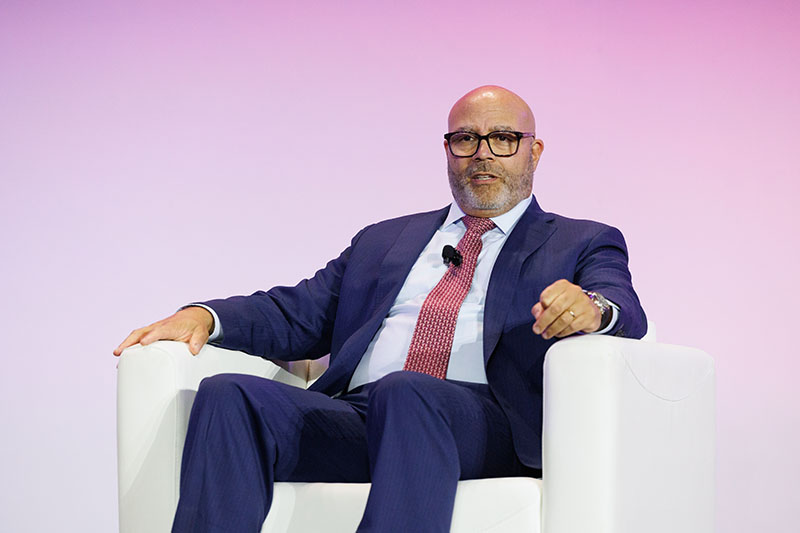
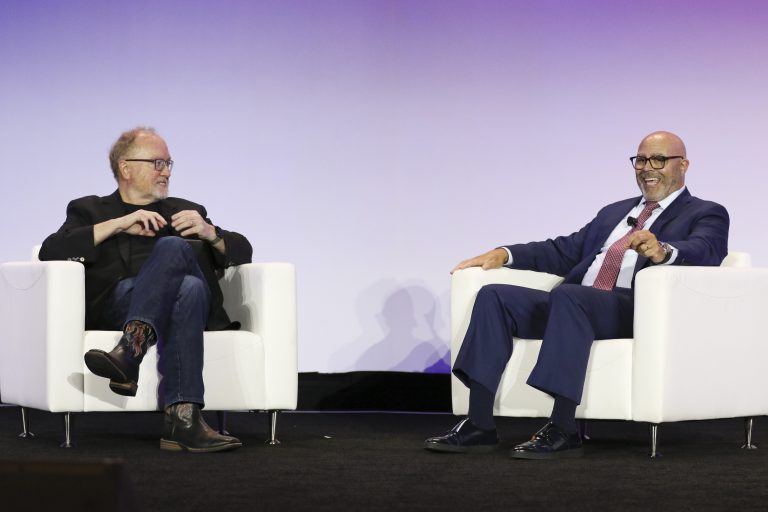
Above and at top: Michael Powell speaks with CableLabs President and CEO Phil McKinney during a general session at SCTE TechExpo in 2023.
Spectrum Leadership and Wi-Fi Advocacy
Michael’s tireless advocacy for unlicensed spectrum and innovative solutions to unlock these wireless resources has been instrumental in shaping the industry's future. His support for spectrum sharing solutions like Citizens Broadband Radio Service (CBRS) has increased access to critical spectrum resources, enabling additional mobile capacity to enhance consumer choice in mobile services while extending high-speed internet access to Americans in rural and underserved areas.
Earlier this year, Michael testified before the House Energy & Commerce Committee, advocating for a more comprehensive approach to spectrum management and emphasizing its essential role in maintaining America's economic and technological leadership. He argued that efficient spectrum use is fundamental to the country's competitive advantage in the global marketplace.
Michael’s advocacy stems from his conviction that “Wi-Fi is more than just convenience — it's a game-changer for our economy and innovation.”
The CableLabs Connection
For many years, Michael has served as a non-voting member of the board of directors at CableLabs. Michael’s policy work and vision for "permissionless innovation" — the idea that individuals and companies should be able to experiment and innovate with new technologies without extensive regulatory barriers — is a philosophy that has guided much of his work and helped create an environment where breakthrough technologies can flourish.
CableLabs President and CEO Phil McKinney reflects on Michael’s impact:
"We at CableLabs are immensely grateful for Michael’s leadership and advocacy. He has certainly contributed to our ability to innovate and build the networks of the future.
"He has been a guiding light on policy in the broadband industry and has brought us to where we are today. Michael has an uncanny ability to balance competing interests, promote innovation and navigate complex government and policy issues.
"The foundations he has laid will continue to benefit all of us for years to come. We’re all stronger, more innovative and better positioned for the future because of his efforts.”
Michael — who was inducted into the Broadcasting & Cable Hall of Fame in 2016 and the Cable Hall of Fame in 2022 — leaves a legacy of impact that will continue to position America as an economic and technology leader far into the future. CableLabs is grateful for his efforts and wishes him success and happiness in his well-deserved retirement.
Innovation
Preparing the Industry for the Next Era of Broadband Innovation

Key Points
- CableLabs helps shape the future of connectivity and advance the technologies that will define it by empowering the people who make it possible.
- Together with SCTE, our member operators and other industry stakeholders, we can build stronger foundations for tomorrow’s networks by investing in collaboration, community and continuous innovation.
The broadband industry is only as strong as the people who power it.
At CableLabs, we believe that innovation isn’t driven by technology alone — it’s driven by the people behind it. That’s why we’re focused on strengthening the industry through three key areas: collaboration, connection and preparation. By creating environments where people can exchange knowledge, engage with peers and accelerate skill development, we’re not just preparing for the future — we’re actively shaping it.
Together with our subsidiary, SCTE, we build our efforts around:
- Collaborating to solve industry-wide challenges
- Connecting experts, engineers and leaders
- Preparing the future workforce at every level
Through these pillars, groundbreaking ideas become real solutions — and the people who bring them to life are empowered to thrive.
Collaborating to Solve the Industry’s Toughest Challenges
From idea to impact, collaboration is at the core of everything we do.
We know that innovation is a team effort. CableLabs’ working groups bring together member operators, vendors and industry peers to align on challenges and develop real-world solutions. Whether it's advancing DOCSIS® technology through hands-on collaboration in our Interop·Labs events or shaping network evolution strategies across our innovation ecosystem, every breakthrough starts with the right people in the room.
This commitment to collaboration is reflected in efforts like the Technology Vision for the industry, which reframes broadband innovation around user experience — and the shared work it takes to deliver it. You can also see it in action through initiatives like our Interop·Labs events, where engineers and vendors test, refine and accelerate the development of new technologies together.
All of this is backed by the work happening inside our labs, where real-world testing environments make it possible to move from concept to deployment — with speed and precision.
This collaborative spirit is what enables solutions to scale. Collaboration within the broadband ecosystem helps align the industry and drive progress — ultimately allowing operators and vendors to accomplish more together. It’s essential that we create impact together by turning shared challenges into real-world solutions. We invite our members and the vendor community to engage with us and one another through CableLabs working groups, SCTE Standards, and a host of interoperability and industry events.
Connecting Industry Leaders
Innovation accelerates when people come together.
The broadband industry moves forward when people have the space to connect, exchange ideas and learn from one another. At CableLabs, we create opportunities — both in person and online — for members to engage in meaningful conversations that drive the industry ahead.
Events like the CableLabs Winter Conference 2025 bring leaders together to align on priorities and explore the technologies shaping tomorrow’s networks. Our ongoing webinars and virtual events offer flexible, accessible ways to stay informed and engaged throughout the year.
You’ll often see CableLabs at industry events — whether we’re attending, speaking or connecting with peers across the ecosystem. At CES 2025, President and CEO Phil McKinney explored how major trends like AI and immersive experiences are shaping the future of connectivity — and the key role the broadband industry will play in delivering those experiences. Catch the key takeaways in this recap.
Whether face-to-face or virtual, every event is a chance to learn and build the relationships that move innovation forward.
Preparing the Future Workforce
The future of broadband depends on the people who build it.
Sustaining innovation means preparing the next generation of broadband professionals — and supporting those already in the field. CableLabs and our subsidiary, SCTE, are committed to empowering these rising professionals through meaningful on-the-job experiences that help them build the skills, confidence and connections they need to thrive in the industry.
To cultivate future technology leaders, CableLabs’ summer internship program welcomes driven and talented university students to gain real-world experience at our Colorado headquarters and contribute directly to industry innovation. At the high school level, our support for programs like P-TECH are helping local underserved students gain hands-on STEM experience and mentorship.
We’re also proud to collaborate with SCTE, which plays a vital role in equipping engineers and technicians with the certifications, standards and skills they need to meet the challenges of today’s networks — and tomorrow’s.
By investing in education, mentorship and continuous training, we’re helping ensure the broadband workforce is ready for what’s next.
Looking Ahead
Collaboration, connection and preparation are foundational to the success of the broadband industry. By investing in people and creating opportunities to work and grow together, we’re not only getting ready for what’s next; we’re helping lead the way.
We look forward to building the future — together.
Technology Vision
How Broadband Service Innovation Can Change the Game for Operators

Key Points
- An integrated network environment will enable broadband operators to deliver seamless, higher-quality connectivity, ultimately enhancing customer experiences and service differentiation.
- Through collaboration with other industry stakeholders, operators can accelerate innovation and deploy new services more effectively, allowing them to stay ahead in a rapidly evolving broadband landscape while mitigating risk.
The future of connectivity will be built on networks that deliver seamless customer experiences. To differentiate themselves in the broadband market, operators must embrace relentless innovation and adaptive service models centered on network evolution, monetization strategies and enhanced user experiences.
As networks evolve beyond traditional boundaries, CableLabs’ ongoing commitment to network platform development, standards and specifications, and vendor interoperability provides a foundation for continuous service innovation.
The shift from infrastructure-centric competition to service-driven differentiation demands a new approach to service delivery. The convergence of fixed and mobile networks — and rapid advancements in satellite network technology — will empower operators to offer next-generation services.
Partnering for Progress in Next-Gen Connectivity
Key to advancing seamless connectivity services is collaborative innovation and problem-solving — a tenet of the Technology Vision for the future of the industry. By joining forces with others in the ecosystem, CableLabs, our member operators and the vendor community can align goals, bring together diverse perspectives, and accelerate the innovation and deployment of new services.
Below, we break down some of the areas of opportunity for differentiated services, what operators should consider now and how they — and other industry stakeholders — can engage with CableLabs in this work.
Fixed Network Evolution: Weighing the Benefits of PON
To meet growing demand for broadband, operators must ensure their networks can deliver higher capacity, lower latency and increased reliability. Passive optical networks (PONs) offer one strategic option to achieve these goals by:
- Extending fiber deeper into networks while maintaining cost efficiency.
- Enabling multi-gigabit speeds and supporting advanced applications to enhance service offerings.
- Providing a scalable foundation for emerging demands such as enterprise SD-WAN, Internet of Things (IoT) and AI-powered services.
Of course, DOCSIS-based HFC networks can also support many of these capabilities, but PON presents an alternative path that could align with some operators’ long-term strategies.
However, deciding when to transition to PON requires careful consideration. Here are three key indicators that may signal the right time to move forward:
- Capacity Constraints and Network Performance: If existing hybrid fiber coax (HFC) networks are approaching capacity limits, PON is one option that can provide the scalability needed to support data-heavy applications like cloud gaming and 8K streaming. When congestion and reliability issues impact quality of experience, operators should assess whether PON can improve performance.
- Long-Term Cost and Infrastructure Strategy: PON simplifies network architecture and supports higher-density service areas. In many cases, it may be a cost-effective long-term investment for operators looking to expand fiber deeper into their networks.
Operator Takeaway: Before switching to PON, operators should consider whether it could help them maximize investment returns and stay ahead of industry demands by aligning network evolution strategies with business objectives.
Advanced Optics: A Path Toward Coherent PON
Advanced optics play a critical role in ensuring that networks can deliver multi-gigabit speeds, support low-latency applications and optimize fiber deployments for both residential and enterprise customers. To meet growing demand, operators need fiber-optic solutions that can scale to meet increasing bandwidth and reliability requirements.
Investing in next-generation optical technologies allows operators to:
- Maximize fiber network efficiency by increasing capacity without requiring excessive infrastructure overhauls.
- Deliver higher-speed, lower-latency services to meet the needs of ultra-HD streaming, cloud gaming and AI-driven applications.
- Prepare for future speeds of 10G and beyond by leveraging advanced optical transport solutions that enable seamless scalability.
Designed for long-term scalability, Coherent PON (CPON) is one such solution. It allows for multi-gigabit symmetrical speeds while also reaching farther and splitting higher, and it improves on spectral efficiency relative to traditional PON technology. It is ideal for high-density areas, enterprise services and next-generation applications that require higher fiber capacity and lower latency.
Operator Takeaway: There is no one-size-fits-all approach to optical network evolution. Operators must assess their growth objectives, market conditions and infrastructure readiness to determine the best path for the future.
Fixed-Mobile Convergence: Leveraging the HFC Network
Fixed-mobile convergence (FMC) is emerging as a key strategy that allows operators to deliver a consistent connectivity experience across broadband, Wi-Fi, cellular and, in the future, satellite networks. As consumer demand for seamless, always-connected experiences grows, operators must find ways to integrate fixed and mobile networks to provide a more unified service.
By leveraging the HFC network for FMC, operators can:
- Reduce reliance on costly mobile spectrum by offloading mobile data to fixed networks where possible.
- Improve customer experience without service disruptions.
- Optimize network efficiency by dynamically routing traffic based on capacity and cost.
FMC allows operators to maximize their existing fixed network infrastructure while enhancing mobile service capabilities. Here’s how operators can take advantage of this shift:
- Wi-Fi Offload: Operators with extensive HFC deployments can offload mobile traffic to their Wi-Fi networks. This reduces cellular network congestion and improves performance by leveraging home and public Wi-Fi hotspots to supplement mobile coverage.
- Seamless Network Handoffs: With improved integration between fixed and mobile networks, as well as network intelligence, users can transition between fixed broadband and mobile networks without disruption. This is an important way to improve customer satisfaction in densely populated areas where mobile networks may experience congestion.
Operator Takeaway: Fixed-mobile convergence represents the next phase in network evolution, offering cost efficiencies, improved service reliability and a superior user experience. Operators who invest in HFC-driven FMC solutions will be well-positioned to compete in a world where customers expect continuous, high-quality connectivity across all their devices.
Security and Privacy: Leveraging Security as a Competitive Advantage
In today’s digital landscape, network security and data privacy are no longer just compliance requirements — they have become key differentiators that influence customer trust, retention and revenue growth. With cyber threats increasing in both sophistication and frequency, operators must move beyond reactive security measures and instead offer proactive, built-in security features that enhance service value.
Investing in advanced security and privacy solutions enables operators to:
- Differentiate their services by highlighting existing premium security features in networks that customers may not see from competitors.
- Reduce operational risks by preventing cyberattacks that could result in downtime, data breaches or regulatory action.
- Enhance customer trust and loyalty by providing robust protections for user data and privacy.
When security is viewed as a revenue driver rather than a cost center, operators can create value-added services by leveraging cutting-edge technology to protect network and customer data. Here’s how:
- In-Home Security: Enabling experiences in the home that are built upon a security foundation for device connectivity, making secure living easy and automated while providing peace of mind.
- Infrastructure and Operations Security: Implementing zero trust architectures ensures that network components don’t rely upon geography for security, but that every element is credentialed and authenticated. This creates challenges for adversarial lateral movement within the network and enhances security for both consumers and enterprises.
- Privacy-Enhancing Technologies: With increasing regulatory scrutiny on data privacy, operators can differentiate themselves by implementing confidentiality in communications — led by cable networks, through secure onboarding of devices and privacy-preserving practices pioneered by the cable industry.
Operator Takeaway: Security and privacy are no longer just back-end considerations. They are now frontline competitive advantages that impact customer decisions. Operators that proactively integrate zero trust security, privacy-enhancing technologies and intelligent threat detection into their service offerings will not only protect their networks but also gain a strategic edge in the market.
Next Steps for Investment in Service Innovation
Continuous service innovation is the heartbeat of the broadband industry. By investing strategically in network evolution, security and service integration, operators position themselves to capture new revenue opportunities and maintain market leadership.
The path forward for market differentiation begins with a careful assessment of where to invest and what to prioritize. If you’re an operator, here’s how to get started.
- Identify Market Gaps: Start by conducting thorough market research, including customer insights and competitor analysis. Using this analysis, identify unmet customer needs and competitive gaps to inform your technology investment strategy and service development roadmap.
- Leverage Industry Collaboration: Industry collaboration accelerates innovation while reducing individual risk. Participation in working groups and interoperability events helps operators share knowledge, validate solutions and ensure compatibility across vendor ecosystems while leveraging emerging technologies to differentiate.
- Adopt Emerging Technologies Strategically: Prioritize investments that align with long-term service objectives and focus on network upgrades that enable multiple service opportunities rather than single-use solutions.
- Measure ROI and Market Impact: Track key performance indicators such as customer response, technology performance and revenue indicators to measure implementation success. Adjust strategies and next steps based on market response.
Accelerating Service Differentiation Through Collaborative Innovation
While collaboration may seem counterintuitive as a differentiation method, working with other industry stakeholders is one of the best ways to develop scalable, real-world solutions that meet user needs. Industry collaboration drives standardization, accelerates technology adoption and reduces deployment risks. Without it, operator capabilities may be limited and could result in lost growth opportunities, poor user experiences and lagging innovation.
CableLabs remains committed to bringing the industry together by fostering collaboration among our member operators and the vendor community. Working groups, Interop·Labs events and other joint initiatives give operators a platform to help shape the networks of tomorrow by pooling resources, sharing best practices and developing interoperable solutions.
Our member operators can explore the newly updated member portal for details about our ongoing work and how to get involved in our projects, or learn more about working groups using the button below.
Events
Last Chance! Shape the Future of Connectivity at Winter Conference
Key Points
- Registration closes Monday, Feb. 24, for CableLabs members to attend Winter Conference 2025 in Orlando, Florida.
- Register today to join us at this exclusive gathering for our member and exhibiting vendor communities to network, collaborate and strategize on the future of the broadband industry.
- Highlights include AI futurist Zack Kass, our keynote speaker, and high-impact sessions covering Network Evolution, Security Evolution, Differentiated Services and AI.
Are you ready to strategize and share at CableLabs Winter Conference 2025? In just a few weeks, an exclusive gathering of CableLabs member operators, approved vendors and industry thought leaders will meet in Orlando, Florida, to discuss and collaborate on how to move the industry forward.
Join us March 10–13 as we work to unlock the value of seamless connectivity and capitalize on the opportunities ahead. Member registration closes Monday, February 24. Secure your spot to take part in charting a course for success in the next era of connectivity.
The Path Ahead
Winter Conference sessions will be an in-depth exploration of the Technology Vision, with each session highlighting individual aspects of the framework — the architectures, protocols, technologies and strategies required for building and evolving the network of the future together. Hear from the experts on topics such as Network Evolution, Security Evolution, Differentiated Services and AI and take home practical insights to inform and inspire your own journey.
By aligning on a shared vision and working together to foster more robust, efficient and sustainable industry ecosystems, our member operators and the vendor community can collaboratively unlock new levels of agility and create solutions at scale. The Technology Vision, developed in collaboration with our members, lays out a roadmap for this more connected, intelligent and secure tomorrow.
Key Winter Conference Highlights
Register today to join us for high-impact sessions, plus hours of additional networking and vendor connections during provided meals and Exhibit Floor receptions. Members-only project meetings will be held Thursday, March 13.
Highlights this year for members and exhibiting vendors include Zack Kass, our keynote speaker. The AI futurist and former head of go-to-market at OpenAI will share his vision for a future powered by AI, offering actionable strategies for leveraging technology to accelerate innovation. Also, new this year, discover how four global startups are disrupting connectivity, focusing on solutions to enhance network performance and reduce latency during our neXus: Startup and Scaleup Spotlight.
View the full agenda for more details. All sessions and demos at a glance:
Tuesday, March 11
Sessions
- Shedding Light on Tomorrow’s Optical Access Networks
- The Rise of AI Automation: A Catalyst for Network Innovation
- Broadband Lunch: Insights Into Forecasting Network Demand
- The What, Why and How of Future HFC Solutions (two parts)
- Shaping the Security Evolution: Strategies from Industry CISOs
- The Power of NaaS: Simplifying Connectivity With Zero Touch Onboarding
- The Next Generation of Wi-Fi Access: Transforming the Connected Home and Beyond
- Breaking Barriers: Buildling Scalable Telemetry for Multi-Access Network Innovation
Demonstrations
- Mobile Wi-Fi Steering to Cellular
- Spectrum Monitoring
- Adversarial Machine Learning and Machine Augmented Penetration Testing
- neXus: Startup and Scaleup Spotlight: Redefining the Connected Home Experience
- neXus: Startup and Scaleup Spotlight: Making Wi-Fi Smarter Through AI-Powered Spectrum Slicing
- NaaS Featuring Traveler Wi-Fi
Wednesday, March 12
Sessions
- What Lies Ahead: Shaping the Future of Connectivity
- Spectrum Policy: Opening a New World of Connectivity Options
- API-First Networks: Building the Foundation for Future Services
- Redefining the Road to Reliability
- Security Evolution: Threats, Technology and Product Differentiation
- A Coherent Path to FTTP Deployments
- The Quest for Seamless Connectivity
- Context Is King: Unlocking Differentiated Services With Smart Networks
- Balancing Economic Trade-Offs in the Last Mile
Demonstrations
- neXus: Startup and Scaleup Spotlight — Unlocking the True Potential of Advanced Networks
- neXus: Startup and Scaleup Spotlight — Revolutionizing Network Operations with Agentic AI
- Harnessing ATSSS: Seamless Traffic Switching for Uninterrupted Connectivity
- Mobile Wi-Fi Steering to Cellular
- Spectrum Monitoring
- Adversarial Machine Learning and Machine Augmented Penetration Testing
Smaller Market Conference
Ahead of Winter Conference, we invite small and mid-tier multi-system operators to join the Smaller Marketing Conference on Monday, March 10, to discuss the issues that are most important to them and their teams. This event is available for CableLabs members and NCTA guests. Registration for Smaller Market Conference is separate from Winter Conference, so if you are planning to attend, please be sure to register for both.
Make Your Mark at CableLabs Winter Conference
Are you ready to impact the future? Join us at Winter Conference 2025, and be part of the conversation on guiding the industry’s path forward. Beyond simply being an opportunity to
Attendees will not only learn more about the Technology Vision. They will also take part in important conversations that will shape the direction and influence the success of that strategic vision.
Registration for Winter Conference 2025 is open for members through Monday, Feb. 24. Secure your spot today.