Advancing The Way We Connect
From co-creating next-generation broadband technologies to aligning a dynamic ecosystem
Where broadband technology innovation takes shape
The technology vision is a high-impact framework that aligns the industry to ensure a new age of seamless experiences, and networks that adapt to the needs of users and devices in real time. Through collaboration with cable operators and technology providers, we’ll create a more advanced cable network that empowers users and fosters a thriving connected environment.

Across the technologies, we provide:

The power of collaboration: exploring our labs
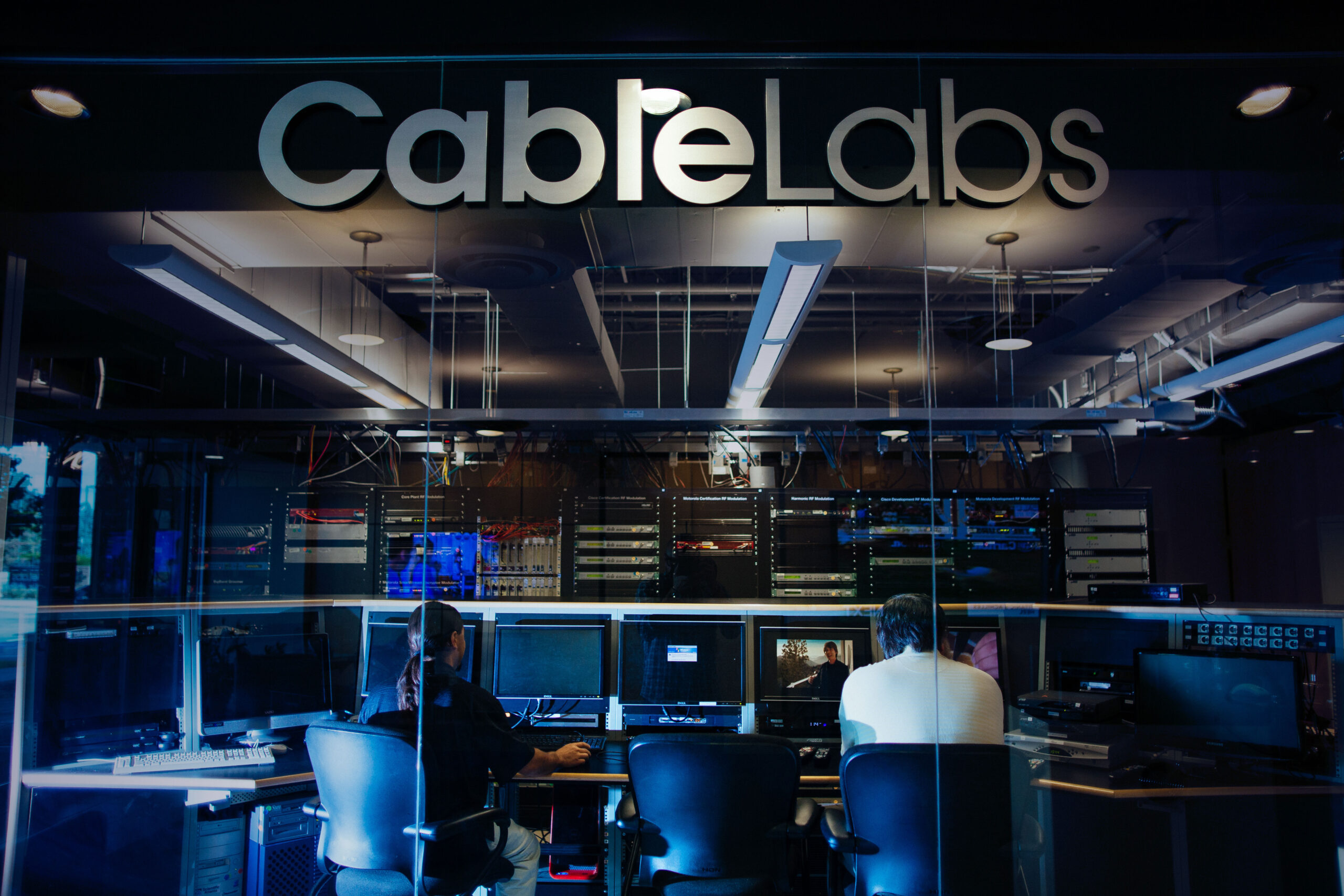
CableLabs specialty labs and environments offer a collaborative space containing the technologies and tools needed to propel ideas through the full life cycle of research, development, testing and deployment.
What’s New
Stay current with the latest from CableLabs.
BLOG
May 21, 2026
BLOG
April 28, 2026
BLOG
April 27, 2026
NEWS
June 8, 2026
NEWS
June 8, 2026
April 29 - May 3, 2024
Cablelabs
Ignite Your Innovation Leadership!
Innovation Boot Camp is a weeklong, hands-on intensive workshop for anyone who wants to be more creative, influential and impactful—and armed with breakthrough ideas. This unique training is based on the FIRE framework for innovation developed by Phil McKinney, President and CEO of CableLabs, as well as keynote speaker, author, and host of the longest running podcast in history.
TOPIC: Next Level Reliability — At each Innovation Bootcamp we select a topic to explore and challenge attendees to apply their new innovation skills to real-world opportunities. We will dive deep into service continuity, reliability and what it means to take networks to new levels of quality of service as a meaningful differentiator in the future.
Why Attend?
- Challenge your thinking on innovation and learn new skills.
- Apply those new skills right away in small teams.
- Go from “inspiration” to “pitch” in one week.
- Receive live coaching from Phil and other expert speaker/coaches.
- Accelerate your “time to innovate” with a customized innovation toolkit.
- Build relationships and educational opportunities beyond Boot Camp.
FAQs
Are meetings confidential?
Yes. Participants should maintain confidentiality within the group and should never discuss pricing.
Can Dual Channel Wi-Fi be integrated with wireless mesh technology?
Yes, Dual Channel Wi-Fi can be integrated with mesh technology.
Can the Programmable Data Plane Be Used for Other Use Cases?
-
Yes, the Transparent Security source-based DDoS use case is just one of many that can benefit from the programmable data plane. Once deployed, this architecture will open our networks to new waves of innovation and can improve many operations we do today.
With the programmable data plane, it is possible to change the behavior of the network after the hardware has been deployed. Using an analytics engine and controller, as we do with Transparent Security, can provide closed-loop automation or a range of network management capabilities.
Providing new services frequently requires installing new purpose-built hardware or deploying a virtual machine (VM). With the programmable data plane, we can now deploy some of these services on existing switches with very good performance. The following list contains some examples of services that can be deployed with a programmable data plane:
- Firewall,
- Future-generation platform for Micronets,
- Managed router as a service,
- Layer 4 load balancer, and
- SD-WAN.
Can Transparent Security Integrate with an Existing Network Monitoring Solution?
-
Yes, you can implement NetFlow- and IPFIX-compatible protocols in P4 to coexist with established network monitoring solutions.
Do I Have to Change My Networking Device Vendor to Use P4?
-
Many of the top networking vendors offer switches that support P4. These switches comply with the P4 language standard and can be reprogrammed in the field.
Does Dual Channel Wi-Fi have to run on 2.4Ghz and 5Ghz?
-
No, Dual Channel Wi-Fi can run entirely on 2.4Ghz, entirely on 5Ghz, or any combination of the two.
Does Dual Channel Wi-Fi require hardware updates?
-
Dual Channel Wi-Fi requires that there be at least two available radios on both the AP and the client device: one for the primary channel and one for the data channel.
Does SNAPS compete with existing commercial OpenStack and Kubernetes?
-
That is not the primary target of SNAPS. SNAPS is targeted at proving an easy to use and freely available open source set of tools that can be used to collaborate and across the industry to reduce fragmentation and efficiency in new solutions and approaches. SNAPS-OO is used to validate interoperability for OpenStack distributions and has been run on the majority of commercial OpenStack offerings. SNAPS-Kubernetes is a certified Kubernetes install and will continue to track the CNCF certification program.
Does SNAPS include an Orchestrator?
-
No, our goal for SNAPS-Kubernetes and SNAPS-OpenStack is to interoperate with any standardized MANO stack.
Does Transparent Security Apply to Business or Residential Customers?
-
Transparent Security can be applied to all customers. With the increased IoT adoption in both the home and work Transparent Security provides the ideal solution for both types of premises.
How are cable companies and CableLabs preparing to support next-generation technologies, such as interactive light field applications?
-
Cable companies understand that consumer needs and expectations will continue to evolve as the next wave of multi-gigabit innovations hits the consumer market. That’s why the cable industry is constantly collaborating with the broader ecosystem of technologists to gain understanding of emerging applications and their network performance requirements. For example, we’re working with the Immersive Digital Experiences Alliance (IDEA)—an industry group seeking to accelerate the commercialization and availability of light field displays that will require staggering amounts of real-time, two-way data. This will help ensure that the cable industry continues to invest in building a more powerful broadband platform capable of supporting the technologies of the future.
How are cable companies preparing to evolve their current HFC networks to meet future demand in terms of speed, bandwidth and latency?
-
The lightning-fast pace of innovation has prompted the cable industry to continuously advance the capacity and performance of its HFC networks. The inherent flexibility of HFC and continued deployment of new cutting-edge networking technologies allows cable to remain well ahead of consumer demand today and in the near future, when next-generation applications like artificial intelligence (AI), video walls and light field technologies become commonplace.
These are just some of the tools available that can significantly improve the performance of cable operators’ networks:
- DOCSIS 4.0 technology provides network technologies that will permit the increased upstream speeds needed to support next-generation immersive experiences and more, enabling symmetric, multigigabit services.
- Active Queue Management (AQM) reduces the amount of time—or latency—required for data to move through the cable broadband network.
- Low Latency DOCSIS® further decreases the average latency to between 1 and 5 milliseconds (roundtrip across the cable network), improving the performance of real-time applications like video calling and gaming.
How can I join the CableLabs community as a member or vendor company?
If your company is a multiple system operator (MSO), please visit the Become a Member page to learn more.
Otherwise, if your company develops and convenes to innovate the hardware, software, platform and technology service solutions used by broadband service providers, please visit the CableLabs Vendor Community page to learn more.
How can industry stakeholders get involved in the Tech Vision?
Fostering industry collaboration is fundamental to CableLabs’ mission. We worked with our members to build this framework, focusing on areas that will have the most impact for them and give them a competitive edge in the industry. We are involved with organizations including ITU-T, IEEE, IETF, WBA, WFA, BBF, TIP, GSMA, CAMARA, 3GPP and others. We encourage members, the vendor community and key industry standards bodies to engage with us and one another through our working groups and Interop-Labs events. Contact us to get involved.
How can my company become a CableLabs member?
To be qualified for membership, a cable company must be an operator of cable-based communication systems which means systems that substantially provide, or previously substantially provided, communication services over a physical network that was founded on last-mile coaxial cable architecture connecting to subscribers. Please note member companies do not include non-cable network platforms, manufacturers or content providers.
Please contact [email protected] or visit our member benefits page for more information.
If you’re not a cable system operator, you may still qualify to engage with CableLabs by applying to join our growing community of technology vendors. The CableLabs Vendor Community is composed of companies who sell infrastructure-relative hardware, software and technology services to MSOs and broadband providers (e.g., products based on HFC, Optical, Wireless, Wi-Fi, AI and security related technologies). As a vendor, once your application is approved, you can get access to non-public documents, including Draft Specifications, contribute to the writing of those documents, or work with us on new technologies. Visit our vendor benefits page for more information.
How did CableLabs and the industry cooperate to develop DOCSIS 4.0?
-
In June 2016, FDX technology transitioned from an innovation project to an industry-wide R&D effort led by CableLabs. It was originally introduced in the DOCSIS 3.1 suite of specifications. CableLabs moved FDX requirements from DOCSIS 3.1 to DOCSIS 4.0 specifications in August 2019. Vendors and member cable operators of CableLabs continue to collaborate on further developing DOCSIS 4.0 to include Extended Spectrum DOCSIS (up to 1.8 GHz).
How did Full Duplex Coherent Optics evolve?
-
Full Duplex Coherent Optics evolved from the need to cost effectively support Coherent Optics technology on networks with only a single fiber available while avoiding retrenching new fiber.. According to a survey of cable operators, 20 percent of existing cable access networks use a single-fiber topology. That means that downstream and upstream transmission takes place on a single strand of fiber. It is estimated that over the next 5 years, this number could grow to 60 percent. Therefore, bidirectional transmission over a single fiber is needed to support single-fiber topologies. Full Duplex Coherent Optics is an elegant solution for the single-fiber transmission in both directions without the need for two laser sources in coherent transceiver.
How did Micronets evolve?
-
There are many different ecosystems and few consistent standards for the various kinds of devices and services being used in homes and businesses today. We realized that a platform was needed that evolves the traditional consumer and business gateway into an advanced and agile system that contains security breaches and provides adaptive security measures as threats evolve.
How did P2P Coherent Optics evolve?
-
CableLabs’ P2P Coherent Optics technology evolved from the impending capacity needs of the evolving Distributed Access Architecture (DAA). Coherent optics technology usage in fiber is 40 times more efficient than non-coherent technologies, such as intensity-modulated direct-detect (IM-DD).
How did SNAPS evolve?
-
SNAPS evolved from fragmented approaches to virtualizing the current network. SNAPS provides a free open source virtualization stack that allows the ecosystem to test new and prove out new solutions and approaches.
How do get I my User ID or Password if I've forgotten it?
If you forget your User ID or password, visit the Password Reset Page to retrieve either one. If you are still having trouble, contact [email protected] for help.
How do HFC networks handle sudden spikes in data traffic, like the ones we’ve experienced during the COVID-19 pandemic?
-
The first half of 2020 proved that cable is very well prepared to handle surges in data usage. As COVID-19 swept across the world, forcing many of us to work and learn from home, we saw unprecedented spikes in both downstream and upstream traffic, with peak downstream traffic increasing by 20.1 percent and peak upstream traffic increasing by 35 percent from March to April in the United States. Despite similar surges around the world, the vast majority of cable operators in the United States, Canada and Europe were able to comfortably accommodate the needs of their customers. Many even reported excess capacity during peak hours. This illustrates the inherent flexibility and scalability of cable’s HFC networks.
How do I apply to join a working group?
To join, visit the working groups section above, click on the working group and login using your CableLabs account credentials. Then follow the prompts to submit your request.
How do I create a CableLabs account?
Employees of CableLabs member and vendor companies can register for an account here.
To learn more about becoming a CableLabs member company, visit the “Become a Member” page.
To learn more about joining the CableLabs vendor community, visit the “CableLabs Vendor Community” page.
How do I engage with CableLabs as a vendor and what are the benefits?
If you’re involved in the cable industry as a non-cable network platform, manufacturer or content provider, we would love to have you on board as a member of our vendor community. There are a few ways you can participate:
- Join a CableLabs Working Group to contribute in Specification and Test Plan drafting which you can then implement for your device. If you’re interested, register for a CableLabs account to sign an NDA and other agreements.
- A Working Group is a group of Subject Matter Experts from CableLabs, MSOs and manufacturers – that have signed the appropriate CableLabs NDA and IPR Agreements – and are working on all or a portion of a CableLabs’ initiative.
- Join as a Visiting Engineer or Contributing Engineer on a part-time basis for at least 6 months. One of the many advantages of this hands-on participation is an opportunity to bring your compliant product to market faster. If you’re interested, register your company for a CableLabs account.
- A Visiting Engineer is an employee of a manufacturer who spends time at CableLabs working on a CableLabs initiative for a certain period of time in accordance with a Visiting Engineer agreement. Contributing Engineers are similar to Visiting Engineers except they are not located at CableLabs.
- Access InfoZone to review Draft Specifications 30 to 60 days prior to public issuance. Request to participate in the drafting of specifications by requesting to join a working group.
- Work with CableLabs on a well-defined co-innovation project. This is an opportunity to combine forces and expertise to bring new technology to market in 3 to 5 years. If you’re interested in partnering with us or learning more about this program, please email us at [email protected].
- Join us in events like Envision Vendor Forum to engage in discussions with other operators and CableLabs staff.
- Envision Vendor Forum is a free event for companies who are building technology for the global cable & mobile industry. This event is your secret weapon to know what the technology strategies will be for the largest cable, broadband and mobile operators around the world.
How do I get access to CableLabs member benefits?
Your company must be a CableLabs member to access benefits. If they are a member, use your company email to register for an account.
How Do You Program the Programmable Data Plane?
-
P4 is the primary language used for programming the data plane. (The project is hosted at https://p4.org.) Switches running P4 chips are controlled via standard GRPC calls and support:
- Protocol independent—P4 programs specify how to process packets.
- Target Independent—P4 is suitable for describing everything from high-performance data center switches to software switches.
- Field Reconfigurable—P4 supports dynamic changes to the way packets are processed.
Extended Berkeley Packet Filters (eBPF) and Micro-C are alternative programming languages that perform similar functions to P4. The eBPF and Micro-C languages are targeted at servers and may be better suited for gateway devices.
How does cable relate to 5G?
5G wireless networks will require tight integration with high-performing fixed broadband networks to offer high-capacity, low latency mobile services. 5G will also utilize spectrum bands that are higher in frequency than has been typical for mobile services to date. For reasons of wireless physics and consumer demand, 5G will utilize a small cell network architecture, with localized radio access points and abundant backhaul. Cable’s broadband networks therefore complement and enable 5G services. More information can be found here.
How does CableLabs choose its Lighthouse Member?
Based on needs to commercialize and ensure broad adoption of the innovation, CableLabs will develop a listing of the attributes it needs in a Lighthouse Member, conduct the research to identify potential Lighthouse Members and then work with the Lighthouse Member that best meets the needed attributes.
How does DOCSIS 4.0 technology contribute to 10G?
-
DOCSIS 4.0 technology is a major step toward reaching the industry’s 10G goal. With full duplex and extended spectrum capabilities integrated into next-generation DOCSIS 4.0 technology, the industry will be able to deliver on that 10 Gbps promise over hybrid fiber coax networks. Learn more about the road to 10G and its technologies.
How does Full Duplex Coherent Optics benefit consumers?
-
Full Duplex Coherent Optics will significantly increase the value of the currently-deployed fiber infrastructure. This technology can be easily implemented in single-fiber networks without the need for new chips for digital signal processing, thus reducing hardware and operation costs. These savings can be passed on to the consumer.
How does Full Duplex Coherent Optics work?
-
Unlike backbone and metropolitan coherent optical networks, cable access networks don’t require multiple directional optical amplifiers in cascade. When dealing with coherent signals, they have much higher Optical Signal to Noise Ratio (OSNR) sensitivity and higher tolerance to the impairments from the reflected noise. These two major factors, access and coherent signals, enable the operation of Full Duplex Coherent Optics. With this new dimension of direction-division multiplexing (DDM) in the optical domain, any coherent wavelength can be used twice, once in each direction, thus doubling the whole fiber system capacity. This full-duplex implementation is not wavelength-selective. It works for short and long wavelengths, and covers the entire fiber transmission window.
How does Micronets benefit consumers?
-
A core pillar of the Micronets platform is ease of use for consumers and business owners. It allows them to connect the devices of their choice and helps them organize and manage their devices with built-in security capabilities. This results in a dynamic and self-organizing system. Furthermore, the Micronets platform leverages APIs to allow machine learning and neural network technologies to dynamically deliver advanced security features where necessary, all while giving the customer complete control.
How does Micronets work?
-
The Micronets platform redesigns a home network into multiple dynamically managed networks or micronets. Each micronet is a trust domain that asserts rules on how devices interconnect and access the internet. Furthermore, Micronets leverages a cloud-based micro-services architecture that integrates intelligent services such as artificial intelligence (AI) based device fingerprinting and IoT security. It also allows straightforward onboarding of new devices as they are added to the network.
How does P2P Coherent Optics benefit consumers?
-
The significant capacity of fiber with P2P Coherent Optics technology indirectly facilitates higher speed tiers and related applications and services that rely on those speed tiers. In the near future, the large capacity made available through coherent optics will lower the cost per bit of optical transport which could be passed along to consumers. P2P Coherent Optical systems enable dense deployment of cellular and wireless services which results in availability and improvement of those services. Also, the efficient use of wavelength and fiber resources with P2P Coherent Optical systems opens up wavelength resources that can be used to improve network reliability and quality of experience.
How does P2P Coherent Optics work?
-
The P2P Coherent Optical system uses amplitude and phase to encode and carry large amounts of data over two polarizations at incredibly high rates, in a manner very similar to the way signals are modulated over coaxial cable in cable plants today. In order to enable coherent reception, a very high-quality, spectrally pure signal and a coherent receiver are used. The receiver uses a high-quality local optical signal that beats and mixes with the received signal. It also compensates and corrects for signal distortion and errors. The different polarizations and the information encoded in amplitude and phase are then separated and decoded. The conversion gain that comes from mixing the received signal with a strong local oscillator signal results in significant improvement in performance.
How does the 10G platform tie into this strategic vision?
The Technology Vision builds upon the pillars defined in the 10G platform: faster symmetrical speeds, lower latencies, enhanced reliability and better security. Along with the 10G platform, the Tech Vision aims to take our networks into a future of seamless, ubiquitous, high-speed connectivity.
How does this technology support the 10G platform?
-
10G puts the consumers’ future first. Built on technology capable of providing necessary speed, capacity and reliability, 10G will power the experiences that consumers demand. LLD technology is one of the innovations that improves broadband experiences and can be deployed widely to all cable broadband subscribers without major new network infrastructure deployments, while remaining cost-effective due to compatibility with existing hardware. LLD makes the 10G network more responsive, allowing consumers to maximize the use of their broadband connection.
How Does Transparent Security Differ from Current DDoS Solutions?
-
Transparent Security mitigates the attack from the home in less than 1 second. Current solutions can take several minutes to recognize the attack and still cannot monitor egress traffic.
How Does Transparent Security Work with Micronets?
-
Micronets, a CableLabs innovation project now being commercialized, creates additional layers of security at the customer premises to help protect devices from becoming infected. To do so, Micronets uses SDN combined with device identity to secure devices on a local network. Transparent Security is focused on identifying southbound devices participating in a DDoS attack and stopping infected packets at the source. The programmable data plane, analytics engine and controller used in Transparent Security can be leveraged by Micronets to improve the packet-processing performance and help Transparent Security confirm the identity of the attacking device.
How is cable broadband service able to achieve speeds comparable or better than fiber to the home?
The cable network is composed of a hybrid of optical fiber and coaxial cable elements, and the specification that enables use of the network for broadband is known as Data Over Cable Service Interface Specification, or DOCSIS®, which was developed and continues to be advanced by CableLabs and its members with the input of vendor technology partners. The cable industry is quickly adopting and deploying the latest generation of DOCSIS technology – DOCSIS 3.1. With the currently available DOCSIS 3.1 technology, a cable operator can achieve a 10 Gbps of download capacity, enabling availability of 1-2 Gbps download speed tiers to consumers. Moreover, the current DOCSIS 3.1 specification provides a path to increasing the download capacity over the coax network from 10 Gbps to 15 Gbps through second and third generation silicon. Each new silicon generation supports broader frequency ranges for DOCSIS, possibly up to the full DOCSIS 3.1 limit of about 1.8 GHz. At the 1.8 GHz range limit, over 1.5 GHz of spectrum can be used for downstream DOCSIS 3.1 channels. At 10 bits per Hertz that is more than 15 Gbps of total capacity.
A more detailed discussion can be found here.
How is CableLabs and the industry cooperating to develop and deploy Micronets?
-
CableLabs is driving the effort to advance cable-based security technologies and create better Internet of Things (IoT) standards across the industry. We’re working with our industry partners and members to bring this technology to the customers. We’re also actively contributing to various standards organizations, such as Wi-Fi Alliance and the Internet Engineering Task Force (IETF), while also supporting government efforts under the National Cybersecurity Center of Excellence (NCCoE) to accelerate the adoption of this technology.
The Rollout: Getting Micronets in Homes and Business
- White Paper: This white paper lays out the vision and architecture of Micronets in greater detail.
- Code: We are releasing the reference code, currently under development, to the open source community in the coming months.
- Our Members and Vendors: We are developing and publishing specifications for standardized APIs for advanced security services based on machine learning and device fingerprinting in collaboration with our members and vendors.
How is CableLabs and the industry cooperating to develop Full Duplex Coherent Optics?
-
The Full Duplex Coherent Optics scheme is being seamlessly incorporated into the ongoing CableLabs’ P2P Coherent Optics specification effort. The companies already involved in the development of P2P Coherent Optics technology have rigorously vetted the concept to ensure it will work as intended, both through analysis and testing.
How is CableLabs and the industry cooperating to develop P2P Coherent Optics?
-
CableLabs’ coherent optics specification effort includes the participation of more than 18 leaders in the networking and optical transport space and a similar number of cable operators. This effort is set to develop 100Gbps, 200Gbps and 400 Gbps P2P coherent link specifications for environments typical in cable access distribution networks.
How is P2P Coherent Optics used to support Distributed Access Architectures?
-
In the DAA cable environment, P2P Coherent Optics are used to establish high-capacity links from the hub to an aggregation node. This aggregation node serves as an aggregation site for lower-capacity 10Gbps Ethernet links that connect to new fiber-deep nodes. The fiber-deep nodes contain remote PHY devices or remote MACPHY devices in a Distributed Architecture, each potentially capable of providing up to 10 Gbps capacity over coaxial networks. Thus, in aggregate the P2P Coherent Optic link could carry more than 100Gbps.
How many data channels will Dual Channel Wi-Fi support?
-
Dual Channel Wi-Fi will support as many data channels as there are radios to support them. For example, if the device has three radios, you can have one radio for the primary channel and two radios for the two downstream data channels.
I am a contractor working with one of your member companies, how do I create a CableLabs account?
As a contractor with one of CableLabs member companies, you can request to create a CableLabs account by going through the account registration page.
On the first page of registration, identify yourself as a contractor as seen on the screenshot.
We will be contacting your manager to verify your information and the projects you indicated interest in.
I have a general inquiry about CableLabs and/or its products. What is the best way to contact you?
Please fill out this form and we’ll be sure to get back to you.
I have a question about DOCSIS® 3.1 Specifications. How can I find the information I need?
If you’re looking for a spec document, please check our Specification Library first. Go to “Search Spec Library” to refine your search by project category, subcategory, and document type. If you are an employee of a CableLabs member or vendor company, you can also check InfoZone, a CableLabs document repository system for non-public information. You must create an online account to access it.
If you’re still having trouble finding what you need, please contact us.
I have a specific question about a modem and my cable company is not able to help me. How do I find the information I need?
As a testing and certification lab, our job is to make sure all the devices we test function according to the manufacturer and industry specifications. Unfortunately, we are not able to address questions about a specific device once it’s been certified. We recommend contacting the device manufacturer directly.
I have an account, but I now work for a different CableLabs member company. How can I update my account?
Please log in to your CableLabs account to update your profile.
I have been unable to find a document referenced in one of your specifications. Where else can I find this information?
Have you checked our Specifications Library? If you don’t find what you need there, try InfoZone. It’s a collection of all non-public specification documents. You need to be a CableLabs member or vendor to log in.
If you’re still having trouble finding what you need, please contact us.
I'm a member of the media and would like to schedule an interview. Who do I contact?
Please contact Ann Finnie, Global Communications Director, at [email protected].
I'm an employee of a CableLabs member company. How do I sign up for an account?
To create an account, please register for an account using your company email address. Once we check everything on our end, we’ll send your login information via email.
I'm having issues logging in to my CableLabs account. How do I get help?
If you’re having trouble creating or accessing your account, please contact [email protected] for assistance.
In simple terms, how does the cable hybrid fiber-coax (HFC) network transmit the broadband signal to the home?
-
As its name suggests, a typical HFC network infrastructure is composed of two main portions: fiber and coaxial. Once the DOCSIS broadband signal is created in the regional hub—or “headend”—it travels via fiber to an optical node, where it’s transformed into a radio frequency (RF) signal. The RF signal then carries the data over the coaxial cable to a cable modem in the subscriber’s home, where it’s typically distributed to all the laptops, smartphones and other connected devices via Wi-Fi.
Is Dual Channel Wi-Fi an amendment to the 802.11 standard?
No, it’s not. We’ve not altered the 802.11 standard.
Is new hardware necessary, and is it easy to implement?
-
DOCSIS 3.1 modems can be software-upgraded to support the low latency features, so no hardware changes are needed. This means that DOCSIS 3.1 modems currently deployed in the field can be upgraded via a software update pushed by the operator. The headend equipment is similar, as well: Low-latency support can be enabled via a software update on the current hardware.
Is SNAPS open source?
-
Yes, the SNAPS program is an open source collaboration between CableLabs Member Companies and the ecosystem partners.
Is the Solution Specific to HFC Networks?
-
No. This architecture and solution will work for any access network, including fiber and mobile.
Lorem Ipsum
Lorem ipsum dolor sit amet, consectetur adipiscing elit, sed do eiusmod tempor incididunt ut labore et dolore magna aliqua. Ut enim ad minim veniam, quis nostrud exercitation ullamco laboris nisi ut aliquip ex ea commodo consequat. Duis aute irure dolor in reprehenderit in voluptate velit esse cillum dolore eu fugiat nulla pariatur. Excepteur sint occaecat cupidatat non proident, sunt in culpa qui officia deserunt mollit anim id est laborum.
Privacy Issues in the Use of Transparent Security Operations
-
Transparent Security uses programmable data plane capabilities in network equipment to enable real-time packet processing, high-resolution packet inspection and in-band network telemetry. Although this new technology allows network operators to identify DDoS traffic patterns, the data required to conduct this analysis includes customers’ personal data because of the granularity required to identify and stop attacks at the source device. This analysis examines the header of each packet, which includes source and destination IP addresses and device MAC addresses, among other data fields. As an organization considers deploying Transparent Security, it should also consider implementing necessarily robust and holistic privacy-protection practices within all elements of Transparent Security and its data flows (e.g., data minimization, processing and data retention limitations, access limitations, encryption), given the potential privacy risks to consumers. For more information, please see our Transparent Security Privacy Warning.
What about video streaming or other traffic that is not sensitive to latency? Will it be worse off?
-
No. Traffic that is more bandwidth-intensive, such as video streaming, will continue to benefit from the significant advances made to increase broadband network capacity. Today, cable operators offer gigabit services to 93 percent of the cable footprint in the United States, and similar advances have been made by cable operators around the globe. The cable industry has invested in the technology that will enable next-generation services of all types.
What Are “Chiplets"?
-
Chiplets are composed of cores of different types, including MIPS-based cores as well as specialized cores used in the programmable data plane. Chiplets refer to an open standard being developed by the OCP Open Domain-Specific Architecture subgroup under OCP Server Working Group.
What are the benefits of a Lighthouse Member engagement?
The full benefits of these engagements are dependent on the successful adoption of the resulting product/technology and can vary widely. Past Lighthouse Members have benefitted by being among the earliest to access and apply the innovations resulting from the engagement. In these engagements, Lighthouse Members have worked directly with the CableLabs innovators and supporting staff to transform compelling concepts into scalable technologies and products. This also included the promotional value of being on the forefront of delivering compelling innovations to their customers via these engagements.
Benefits could include:
- Testing the solution or technology early to ensure alignment to their own strategic goals
- Identify and plan changes necessary for back office and field operations
- Help drive the requirements in the solution as it gets development
What are the benefits of being a CableLabs member company?
For over 30 years, we’ve worked with some of the biggest players in the cable industry to research and develop cutting-edge technologies that connect millions of people around the world. By becoming a CableLabs member, you will get the support you need to innovate, develop, and test next-generation products that will shape the future.
Visit our member benefits page for more information.
What are the Lighthouse Member’s responsibilities?
The Lighthouse Member responsibilities will be determined between the Lighthouse Member and CableLabs on a case-by-case basis. Generally the Lighthouse Member implements the CableLabs innovation in their network to gain further knowledge and actual commercial results that can be shared with the cable industry.
What are the results of Dual Channel Wi-Fi implementation?
-
Download the Dual Channel Wi-Fi™ Performance Test Report. This test report outlines the results of performance testing conducted on the Dual Channel Wi-Fi implementation.
What are the Tech Vision’s key themes and focus areas?
By defining three future-focused themes, the Tech Vision aims to provide a concise model for building adaptive networks. The themes — Seamless Connectivity, Network Platform Evolution and Pervasive Intelligence, Security & Privacy — establish a framework for a context-aware network that is smart, secure, sustainable and reliable and built for the future. The core areas focus on defining network capabilities that are flexible, reliable and able to deliver quality services and user experiences.
What certifications do you test for and how do I submit a device for certification?
All certification testing is now done through Kyrio, a subsidiary of CableLabs. Working in close collaboration with cable operators and equipment manufacturers, we’ve developed various specifications to ensure interoperability between all the cable devices, modems, wireless access gateways, set top boxes, TVs, phones and other smart devices that pass through the Kyrio testing lab.
Kyrio performs a stewardship role for all Certification and Qualification Programs designed by CableLabs. Kyrio’s testing services teams are the same people that ran the CableLabs test programs before Kyrio was created; it’s the same folks running the same lab.
You can learn more about the types of certification testing we do and how to submit your device for certification on Kyrio’s website.
What does “fiber deep” mean?
-
“Fiber deep” is a name given to cable operators’ ongoing effort to push the fiber portion of their HFC networks closer to subscribers’ homes. They do this by extending fiber beyond the existing optical node to new optical nodes and then connecting those optical nodes to multiple shorter coaxial networks that serve fewer subscribers. This results in more available bandwidth for each subscriber.
What domains does CableLabs share information from?
- cablelabs.com
- cablela.bs
- Ondar.cablelabs.com
What is a CableLabs working group?
CableLabs working groups are collaborative groups focused on addressing key challenges and designing solutions to advance network technology. Groups consist of CableLabs members, vendors and industry stakeholders who work together on a specific challenge.
What is a Lighthouse Member?
A Lighthouse Member is a CableLabs member that works together with CableLabs’ during initial efforts to commercialize a select innovation, technology and/or related specifications and standards that are applied in products/services for the benefit of the cable industry and its customers. The Lighthouse Member’s contributions include but are not limited to testing or otherwise applying the technology with the intent to develop products or services that will be included in its offering.
What is Cablelabs?
For over 30 years, CableLabs has been at the forefront of innovation, transforming how humans, communities and industries connect. Dating back to the launch of HFC in 1992 to the start of DOCSIS® in 1994, CableLabs has directly impacted the landscape of tomorrow. With its in-house R&D teams and innovation teams, as well as its ecosystem of partners from both inside and outside the cable industry, CableLabs works with academia, government, vendor ecosystem and beyond to grow the communities of tomorrow. The goal is to create a future that is more useful, more connected and more global, by repeatedly pushing the forefront of innovation, transforming concepts and impossibilities into practical and adoptable everyday uses.
More information on CableLabs can be found here.
What is CableLabs’ role in a Lighthouse Member engagement?
CableLabs will deliver a Proof of Concept, code, Alpha/Beta products, and work with the Lighthouse Member to determine the best approach to apply CableLabs’ innovation to ensure its broad adoption for the benefit of the cable industry.
What is Full Duplex Coherent Optics?
-
Different from dual-fiber or dual-laser coherent bidirectional connections, Full Duplex Coherent Optics uses a single wavelength and a single fiber for simultaneous coherent optical communications in both directions, thus doubling the system capacity. A special optical component, called an optical circulator, is required to directionally duplex the bidirectional coherent signals. With this new dimension of direction-division multiplexing (DDM) in the optical domain, any coherent wavelength can be used twice, once in each direction, thus doubling the whole fiber system capacity. This full-duplex implementation is not wavelength-selective. It works for short and long wavelengths, and covers the entire fiber transmission window.
What is involved?
Our working group participants are passionate about technology and committed to proactive engagement. They have the support of their organization in participating. Groups typically meet for 4-6 hours each month and spend additional time preparing for these meetings. Participants may also wish to attend occasional face-to-face meetings hosted at CableLabs’ headquarters to collaborate and network. Working group members must also sign a participation agreement.
What is latency and what does LLD technology do to improve it?
-
Latency is the time it takes for data to traverse the network, usually noted in milliseconds. It should not be confused with “bandwidth” or “throughput,” which defines how much data can be sent over the network in a given period of time, usually noted in megabits per second (Mbps).
For many years, the cable broadband industry has been increasing network bandwidth to stay ahead of demand. However, for many applications, latency is now becoming more important, especially applications that are sensitive to delay, such as online gaming, web browsing, Skype and FaceTime. LLD is one of CableLabs’ latest efforts to reduce broadband network latency in order to improve the user experience for these latency-sensitive applications—though this is hardly the first latency improvement that CableLabs has developed. For example, current DOCSIS 3.1 networks already include features such as Active Queue Management (AQM) that make significant improvements in latency. LLD technology takes these efforts to the next level.
What is Listen-Before-Talk (LBT)?
-
Wi-Fi is often referred to as “polite” because it uses a procedure called Listen-Before-Talk (LBT). LBT is a contention-based protocol that requires data-transmitting devices to listen and wait for a given frequency band to be clear before sending data. If the device (access point [AP] or station) does not detect transmissions, it proceeds to send data. If the device does detect transmissions, it waits for a random period of time and listens again for a clear frequency or channel before commencing transmission. Dual Channel Wi-Fi maintains LBT to ensure spectrum sharing fairness while increasing performance.
What is Nielsen’s Law?
The telecommunications industry typically uses Nielsen’s Law of Internet Bandwidth to represent historical broadband Internet speeds and to forecast future broadband Internet speeds. Mr. Nielsen predicted many years ago the high-end user’s download connection speed grows by approximately 50% compound annual growth rate (CAGR). This prediction has largely held true over the past 35 years (1983-2018).
What is P2P (Point-to-Point) Coherent Optics?
-
P2P (Point-to-Point) Coherent Optics is a technology for creating a network connection between two points that uses coherent optical transceivers. In the context of the CableLabs’ Coherent Optics specification project, it is an access-optimized coherent optical transmission link that is tailored to address the particular traffic aggregation needs of cable and shorter lengths distribution networks in terms of capacity, network topologies, and deployment scenarios.
What is the cable industry doing to increase the security of HFC networks?
-
As networks grow more complex, network security becomes increasingly important to individuals and businesses all around the world. To stay ahead of ever-evolving cyber threats, CableLabs and the cable industry are deploying a variety of technologies and tactics to keep our networks and data safe. For example, we’ve developed a smarter and more agile network management system called CableLabs® Micronets that organizes all of the connected devices on a single network into multiple dynamically managed subnetworks that can effectively isolate outside threats. Other tools include Wi-Fi Easy Connect, a mechanism that imprints each connected device with secure and unique credentials, allowing systems like Micronets to identify and manage each device as necessary. CableLabs and other cable industry representatives are also actively engaged with manufacturers and various industry organizations, such as OCF, to increase the security and interoperability of IoT devices.
What is the cost of becoming a CableLabs member company?
Membership dues are determined on the basis of cable revenue. Please reach out to the Membership Team at [email protected] for more information.
What is the cost of becoming a CableLabs vendor?
There is no fee for a vendor to become involved with CableLabs. If you’re interested in becoming part of a Working Group or participating as a Visiting or Contributing Engineer, contact us inquiry form and we’ll get back to you with further details.
If you’re interested in only reviewing Draft Specifications, request to participate by creating a vendor account, selecting projects you are interested in, and signing the related agreements.
What is the difference between DOCSIS 3.1 specifications and 4.0 specifications?
-
The difference in specifications is an increase in upstream capacity and more options for operators to increase downstream capacities. Current DOCSIS 3.1 cable modems support capacities up to 5 Gbps downstream and 1.5 Gbps upstream. DOCSIS 4.0 cable modems will support capacities up to 10 Gbps downstream and 6 Gbps upstream.
What is the difference between Dual-Band Concurrent Wi-Fi and Dual Channel Wi-Fi?
-
Dual-Band Concurrent Wi-Fi is enabled by the latest Wi-Fi chipsets and is beginning to be incorporated into end-user devices. It allows for the simultaneous use of two or more bands in both upstream and downstream but doesn’t address airtime contention. Dual Channel Wi-Fi solves for airtime contention by adding one or more data channels. The primary channel is used for upstream and small downstream packets, and the others are used for large downstream and time-critical data, like video. A Traffic Filter Profile triages the data based on packet size, source IP, source port, destination port and protocol type and sends data to the appropriate channel, thus significantly easing congestion.
What is the purpose of a Lighthouse Member engagement?
These engagements allow the Lighthouse Member to be a leader in applying a CableLabs innovation and demonstrate its commercial and economic benefit in the context of its business and ecosystem.
- A Lighthouse Member will have certain attributes including, but not limited to networks, customers, knowledge and expertise, resources, or the strategic interest necessary to accelerate the application or adoption of CableLabs innovation at scale.
- A Lighthouse Member enables CableLabs innovation beyond what CableLabs can do itself and assists in making sure the innovation moves out of the lab and accrues to the benefit the wider cable industry.
What is the Technology Vision?
The Technology Vision is a strategic framework designed to advance innovation and technology development in the broadband industry in the coming years. It aims to foster alignment and drive scale while developing a healthy ecosystem for CableLabs’ member operators and the vendor community. With a goal of revolutionizing connectivity, the Technology Vision sets the course for a more adaptive, intelligent network that unlocks new possibilities for operators and their customers.
What makes Full Duplex Coherent Optics possible?
-
Unlike backbone and metropolitan coherent optical networks, cable access networks don’t require multiple directional optical amplifiers in cascade. When dealing with coherent signals, they have much higher Optical Signal to Noise Ratio (OSNR) sensitivity and higher tolerance to the impairments from the reflected noise. These two major factors, access and coherent signals, enable the operation of Full Duplex Coherent Optics.
What portion of the HFC network is fiber?
-
The largest portion of the HFC network is composed of fiber that connects a regional hub to optical nodes. Only the last half a mile or so—the distance between an optical node and customers’ homes—is made up of coaxial cable. Since the early days of HFC, cable operators have been consistently investing in fiber-optic technologies, adding tens of thousands of fiber miles to their infrastructure. According to the most recent 2019 S&P Global Report, cable operators Charter and Comcast are among the top 10 providers in terms of fiber miles in the United States.
What strategies and technologies are currently deployed to enhance the capabilities of HFC networks?
-
Cable companies are using a range of technologies and methods to prepare their HFC networks for the multi-gigabit future, such as:
- Fiber deep: Many operators have embraced the “fiber deep” approach of extending the fiber portion of the network closer to customers’ homes, thus increasing the bandwidth capacity available to each customer service group.
- Distributed Access Architecture (DAA): DAA is used to move—or distribute—some or all of the DOCSIS network functionality from the regional hub site to the optical node or other similar remote locations. This allows cable operators to substantially increase the available capacity in each fiber node, as well as customize their network architecture to meet the current and future needs of their customers.
- Coherent Optics: To increase efficiency and capacity, cable companies can use Point-to-Point (P2P) Coherent Optics technology to send vast amounts of data at incredibly high speed—up to 100 Gpbs per second—over the fiber optic portion of their HFC network.
- DOCSIS 3.1 technology: This is the current industry standard for providing high-quality Internet access over HFC networks. It provides significant performance enhancements over the previous version of DOCSIS that include increased spectral efficiency, more sophisticated forward error correction and additional spectrum of up to 1.2 GHz, as well as optional features that could enable capacities of up to 10 Gbps downstream and 2 Gbps upstream.
What technologies are used to enhance the reliability of cable HFC networks?
-
Consumers everywhere are relying on cable networks to deliver interruption-free services. Whether people are working from home, talking to their doctor or playing a game online, any outage—no matter how short—is deemed unacceptable. Although a 100 percent failure-proof technology doesn’t exist, we can significantly reduce the chances of a problem occurring by using tools such as Proactive Network Management (PNM) and Profile Management Application (PMA). PNM uses a combination of network monitoring and maintenance techniques to collect and then analyze data for abnormalities, which can be addressed before they can potentially lead to failure. PMA allows subcarriers to use various modulation orders, allowing the network to be operated with lower signal-to-noise ratio (SNR) margins and increasing the overall capacity of the network. This is especially useful for optimizing performance in response to changes in the physical characteristics of the network and, potentially, to changes in subscriber usage patterns, such as those triggered by COVID-19.
What technologies does CableLabs develop?
CableLabs innovation and R&D efforts are focused in the areas of wireless network technologies, including in both licensed and unlicensed spectrum; wired network technologies, including both fiber and coaxial cable technologies; cybersecurity; and artificial intelligence.
Where can I find information about employment or internship opportunities at CableLabs?
We are always on the lookout for future thinkers and innovators to join our team. It doesn’t matter if you’re still in school or are a seasoned professional looking for new opportunities. If you’re passionate about technology, let’s chat. You can see a a list of current open positions and internships and apply here.
Where can I find Micronets resources?
-
Read the detailed technical documentation and check out the source code regarding the Micronets platform.
Work with us on implementation by contacting Darshak Thakore at [email protected].
Where can I find SNAPS resources?
-
All the tools outside of SNAPS-OO can be found on Github. See SNAPS Portfolio Features for direct links to all the tools
Where do I find a list of participants to the DOCSIS and IPR agreements?
We keep a current list of participants to the DOCSIS and IPR agreements linked from the Vendors: How to Engage page.
Which platforms will Dual Channel Wi-Fi be available on?
-
We have finalized our software contribution to RDK and are testing this implementation on the ARRIS XB3 and the Pace XI5, as well as a Windows 10 package and scripts for MAC OS and Linux. CableLabs worked with Edgewater Wireless to develop a dual channel implementation for OpenWrt platforms.
Who can apply to join a working group?
Some working groups are for employees of CableLabs member companies only, while others include industry stakeholders such as NDA vendors and core decision-makers. The primary qualification is a passionate interest in technology and a commitment to active participation.
Who funds Lighthouse engagement activities?
Generally, CableLabs and the Lighthouse Member will fund their respective activities/contributions to the work necessary achieve the mutually agreed objective(s). As applicable or necessary, CableLabs and the Lighthouse Member may agree explicitly to pool resources to complete some portions of the associated work.
Who is this technology for?
-
LLD was designed for users who run latency-sensitive applications such as real-time gaming and video calling. It even improves the user experience for web browsing. And businesses will enjoy better performance for interactive cloud-based applications. As an extension to the current DOCSIS 3.1 specification, manufacturers will need to integrate this technology into their products. Operators will then be able to deploy it via a software update to existing DOCSIS 3.1 equipment. It can also coexist with earlier equipment that does not support LLD technology.
Who owns the Intellectual Property generated during the course of the work between CableLabs and Lighthouse Member?
Any questions as to ownership of intellectual property will be decided on a case-by-case basis between CableLabs and the Lighthouse Member and consistent with the terms of the CableLabs membership agreement.
Why are HFC networks built to allow for more downstream data capacity than upstream?
-
The asymmetrical design of cable’s service tiers is largely driven by customer usage patterns. Simply put, today’s users download more data than they upload. If you look at the top individual applications across network providers worldwide, such as YouTube at 15.94 percent of total traffic and Netflix at 11.42 percent, they’re all downstream-centric. Although we’re seeing a significant increase in the usage of apps that require more upstream capacity, like video conferencing and gaming, this number is still much lower than the overall downstream traffic—roughly 10 percent. In the near future, as we move toward more upstream-intensive applications such as immersive video and interactive light field apps, cable is well prepared to adjust its services to support symmetric multi-gigabit speeds in both directions.
Why did CableLabs develop this technology?
-
Lower latency is becoming a much-requested feature in an increasingly competitive marketplace. With cable’s widely deployed gigabit networks, bandwidth is often abundant, although some applications still need lower latency to create consistently great user experiences. Applications that have been limited by latency have, as a result, not been able to take advantage of increasing broadband speeds. LLD unlocks the benefits of increased bandwidth for customers who use these applications.
Why is LLD technology needed?
-
As bandwidth increases and more traffic is sent over the network, that traffic can cause delays at various points across the internet. Because some online services and applications are more sensitive to latency than bandwidth (think of a “choppy” Skype call while using a 100 Mbps connection), it is important to be able to improve latency in broadband. This will become even more evident as more latency-sensitive technologies emerge in medical, vehicular and other market segments where latency can cause health and safety risks.
Will Adding P4-Enabled Hardware Increase the Cost of Future Generations of CPEs?
-
The expected CPE costs should be similar to that of the general-purpose CPUs currently performing network functions. These CPUs would be swapped out for a chiplet.
Will Dual Channel Wi-Fi be supported on phones and laptops?
-
Dual Channel Wi-Fi devices require two or more radios. With dual-band concurrent Wi-Fi chipsets becoming widely available, more and more devices will be Dual Channel Wi-Fi capable with a software update. In the interim, devices that support external Wi-Fi adapters can be used.
Will my competitors be in my working group?
Yes. In some cases you will be working with industry competitors. The goal is to create collaboration and alignment around a shared vision in a neutral environment.
EVENT LOCATION
Cablelabs
EVENT DETAILS
April 29 - May 3, 2024
$1,350 per person
Registration Deadline:
Members-Only Event
First Last Name
Position, Company
Lorem ipsum dolor sit amet.
First Last Name
Position, Company
Lorem ipsum dolor sit amet.
First Last Name
Position, Company
Lorem ipsum dolor sit amet.
First Last Name
Position, Company
Lorem ipsum dolor sit amet.
Please note: Updates will be made leading up to the event. Times shown below are Eastern Daylight Time (EDT).
12:00pm - 12:00pm |
Break |
12:00pm - 12:00pm |
Session TitleLorem ipsum dolor sit amet, consectetur adipiscing elit. Fusce luctus ex at vestibulum lobortis. Quisque sapien felis, vehicula ac dolor at, placerat dictum libero. Nam urna nisi, porta sed interdum vestibulum, iaculis sit amet lorem. Proin in gravida nunc, et condimentum massa. Sed efficitur orci a sagittis lobortis. Moderator: First & Last Name, Title, Company Speakers: |
Testimonials
Bootcamp broke that fear of trying to innovate and helped me create a systemic process for my ideation.
Join us at Innovation Bootcamp
Let’s Collaborate
Join a global community of thought leaders that drive the next generation of technology. By having access, you will gain insight to emerging technology advancements and the ability to shape specifications, preparing you for the future.