



DOCSIS® technology continues to evolve at a rapid pace. Cable operators have continued deploying DOCSIS technology and providing high-speed internet services to hundreds of millions of customers around the world. The year 2025 was exciting for cable networks, both in terms of deployments of new technology and continued innovation in the development of technology for the next quarter of a century.
A year ago, our blog post “The Evolution of DOCSIS Technology: Building the Future of Connectivity” walked through how DOCSIS technology evolution fits in the broader connectivity roadmap, and how CableLabs and the cable industry as a whole are already thinking about and working on what comes next. In 2026, the conversation has shifted from what’s theoretically possible to what’s actually happening in the field.
DOCSIS 3.1 Technology: A Decade In and Still Climbing
It’s been a decade since DOCSIS 3.1 technology debuted on the world stage, and cable operators continue to deploy it in all major markets. During that time, operators have upgraded the outside plant to support mid-split and high-split (increased upstream spectrum) technologies across their footprint. In parallel, the networks have transitioned to the Distributed Access Architectures (DAA), replacing older analog nodes with new remote PHY devices (RPDs). DOCSIS 3.1 continues to be a strong competitive technology.
In 2025, DOCSIS 3.1+ cable modems with additional (4+) OFDM channels were certified and are being both chosen and deployed to get even higher downstream speeds on the network. In 2025, DOCSIS 3.1+ cable modems with additional downstream (four or more OFDM) channels were certified; operators are now deploying these channels to achieve even higher downstream speeds on the network.
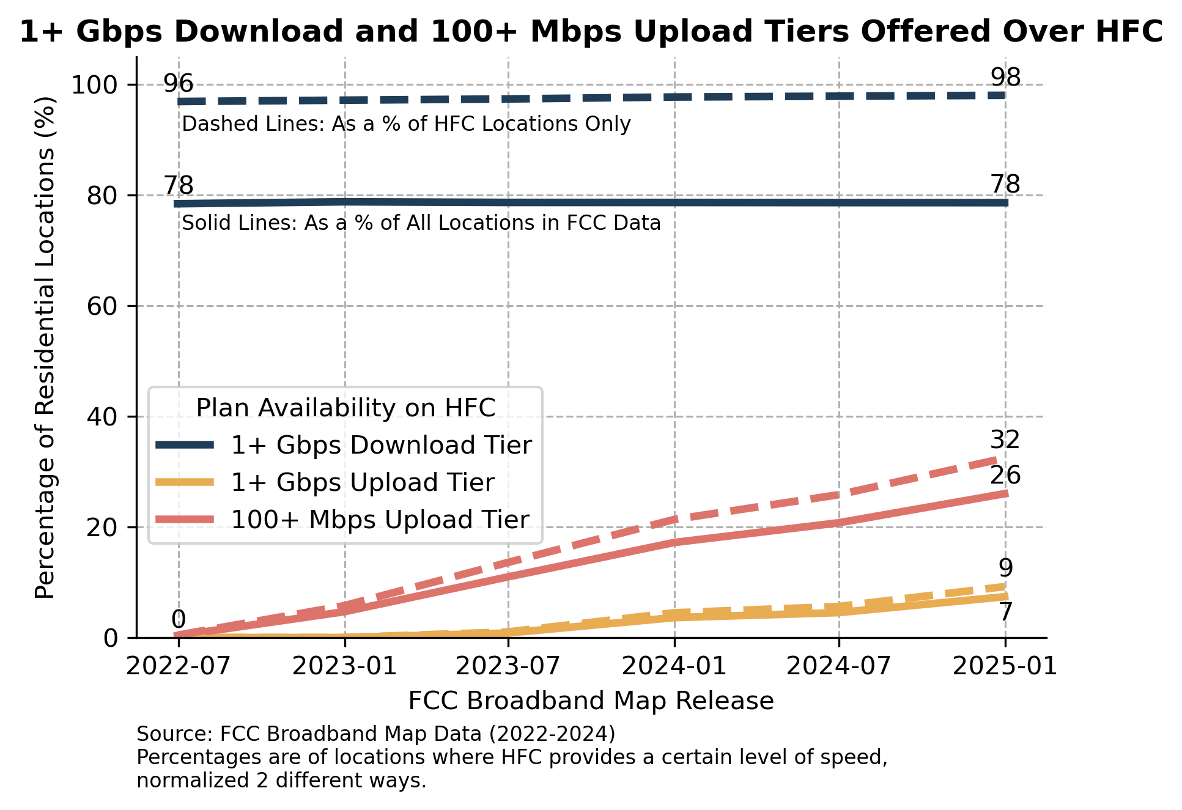
CableLabs’ analysis of FCC National Broadband Map data for the United States (June 2022 through December 2024) shows a strong presence of DOCSIS 3.1 deployments and an accelerating transition to midsplit and highsplit HFC plants. As of December 2024, 98% of all residential locations served by cable operators have access to 1+ Gbps downstream tiers over HFC. Over the same period, the share of locations with access to 100+ Mbps upstream tiers over HFC increased from about 1% to 32%, while 1+ Gbps upstream increased to 9%.
The FCC data analysis and graph below are credited to Jacob Malone, principal strategist and senior director, Network Demand Strategy, CableLabs.
Although multi-gigabit speeds are important, user experience increasingly comes down to latency, consistency and responsiveness — especially for cloud gaming, collaboration tools and immersive applications. That’s where Low Latency DOCSIS (LLD), introduced in DOCSIS 3.1 (and carried forward into DOCSIS 4.0), plays a key role. Operators such as Comcast have made strides in deploying this technology to enable a low-lag connectivity experience for their customers.
At the same time, improving network reliability has become a major focus of cable operators worldwide. Using data from the network, tools such as Profile Management Applications (PMA) and Proactive Network Maintenance (PNM) have become a vital part of network operations by maintaining connectivity, identifying issues and ultimately reducing downtime, as networks push toward higher utilization and complex channel configurations.
DOCSIS 4.0 Technology: From Interop Milestones to Deployment Readiness
Now let’s talk about DOCSIS 4.0, starting with interoperability events and multi-vendor readiness. Over the past year, interoperability events have moved from early experimentation to demonstrating performance and interoperability at scale.
At the June 2025 DOCSIS 4.0 Interop, multiple CCAP cores, RPDs and cable modems from various suppliers operating together in a distributed access architecture, were able to achieve downstream DOCSIS throughput reaching 14 Gbps across a multi-vendor network. A few months later, at the August DOCSIS 4.0 and DAA Technology Interop event, vendors showcased record-setting setups built on that foundation, demonstrating 16.25 Gbps downstream throughput across two load-balanced DOCSIS 4.0 modems. Demonstrations at SCTE Tech Expo’25 showed 2×2 DOCSIS 4.0 RPDs enabling unprecedented capacity.
Beyond the speed records, these results confirm that DOCSIS 4.0 can comfortably achieve 10G-class downstream performance over the HFC network; that multi-vendor interoperability of CCAP cores, RPDs and cable modems is real, and that virtualized, cloud-native CMTS platforms are a key part of the DOCSIS 4.0 story. Upstream speeds up to 3 Gbps and 5.5 Gbps were also demonstrated in different configurations. Taken together, these accomplishments validate the 10G roadmap that the cable industry has laid out and give operators confidence that DOCSIS 4.0 can compete head-to-head with fiber in both performance and operational flexibility.
Operators are in various stages of assessing and testing outside plant components and equipment, ultimately to support the upgrade to DOCSIS 4.0-based services. Over the last year, most operators in their individual labs have been evaluating various equipment. This includes outside plant components, such as taps, passives, and amplifiers, along with RPDs, CCAP cores, and cable modems needed for DOCSIS 4.0 deployments. Some operators are beginning to deploy these components into the network, outside plant components first (e.g., the smart amplifiers), then DOCSIS 4.0 RPDs and CCAP cores, and ultimately the cable modems to the customer homes, along with any necessary passive component upgrades. Deployments enabling the full duplex mode of operation have already seen great success, and the stage is set for successful deployments of frequency division duplex mode of operation as well.
This year, it’s going to be exciting to see these DOCSIS 4.0 deployments begin to scale around the world.
But wait, there’s more!
In 2026 and Beyond: Extending DOCSIS 4.0 to 3 GHz — and Looking to 6 GHz
CableLabs CEO Phil McKinney announced at SCTE TechExpo25 that CableLabs will begin industry work focused on enabling the HFC network to support DOCSIS data transmission up to 3 GHz. This extension can enable up to 25 Gbps of aggregate capacity — a leap that positions HFC networks not just to meet demand, but to stay well ahead of it.
The 3 GHz specification work has since begun with wide industry participation from both the cable operator side and the vendor community. This includes technologists from operators’ engineering organizations, CM vendors, silicon vendors, RPD manufacturers, CCAP core suppliers, along with outside plant component folks such as amplifier vendors, taps and passives manufacturers, et al. The work includes analyzing the plant models and characteristics of the network at higher frequencies and understanding the ability to build outside plant components to support high-fidelity operations at these higher frequencies. As we get agreement on these analyses, a new optional annex will be developed and added to the DOCSIS 4.0 specifications. The extension of the spectrum will allow DOCSIS signals to use the 1.8 GHz to 3GHz frequency range, opening up spectrum for additional downstream OFDM channels. The goal is to make these 3GHz requirements a part of the current DOCSIS 4.0 technology as an optional annex and enable the choice for the operators and vendors to test, develop and deploy interoperable solutions with these enhanced capabilities in markets that need them.
As McKinney also discussed at TechExpo, CableLabs and thought leaders in the industry are analyzing and evaluating the potential of HFC networks all the way to 6 GHz. This expansion could ultimately provide up to 50 Gbps of aggregate capacity and open the door to exciting new use cases that leverage the HFC networks we have today. This research is happening in the background, with various analyses on plant characteristics, tap design, amplifier design, and analysis of HFC network upgrade paths. Once the fundamental building blocks for transmission up to 6 GHz are validated, the technology development and specification work for another leap in DOCSIS capability can begin.
Connecting Past, Present and Future
Taken together, these developments extend the cable technology arc further:
- The past, DOCSIS 3.1 technology, has established a solid, backward-compatible foundation that brought gigabit speeds to market and prepared the HFC plant for higher splits and DAA.
- The present, defined by DOCSIS 4.0 technology, is where operators are beginning to deploy multigigabit services, validating 10G-class performance and building multivendor, virtualized networks.
- The future is now anchored in concrete work on a 3 GHz extension to DOCSIS 4.0 solutions and early planning for 6 GHz operation, ensuring that DOCSIS technology has a roadmap well beyond today’s generation.
It’s an exciting time to be working on HFC and DOCSIS technologies. The past year has shown that the industry is not only keeping pace with demand but actively shaping what the next decades of cable broadband will look like — from the networks already in the field to the specifications and research that will power the internet of the future.